

On July 1, 2025, the Australian Federal Government will officially launch the Cheaper Home Batteries Program, marking one of the most significant developments in household energy policy in recent history. Backed by a $2.3 billion expansion of the Small-scale Renewable Energy Scheme (SRES), this initiative is designed to dramatically accelerate battery adoption across Australia. The goal? To support over one million new battery installations by 2030 and give households greater energy independence.
In this guide, we unpack everything Australians need to know about the new federal solar battery rebate—from how much you can save, to eligibility requirements, to what it means for the energy future of Australian homes and businesses.
What is the Federal Solar Battery Rebate?
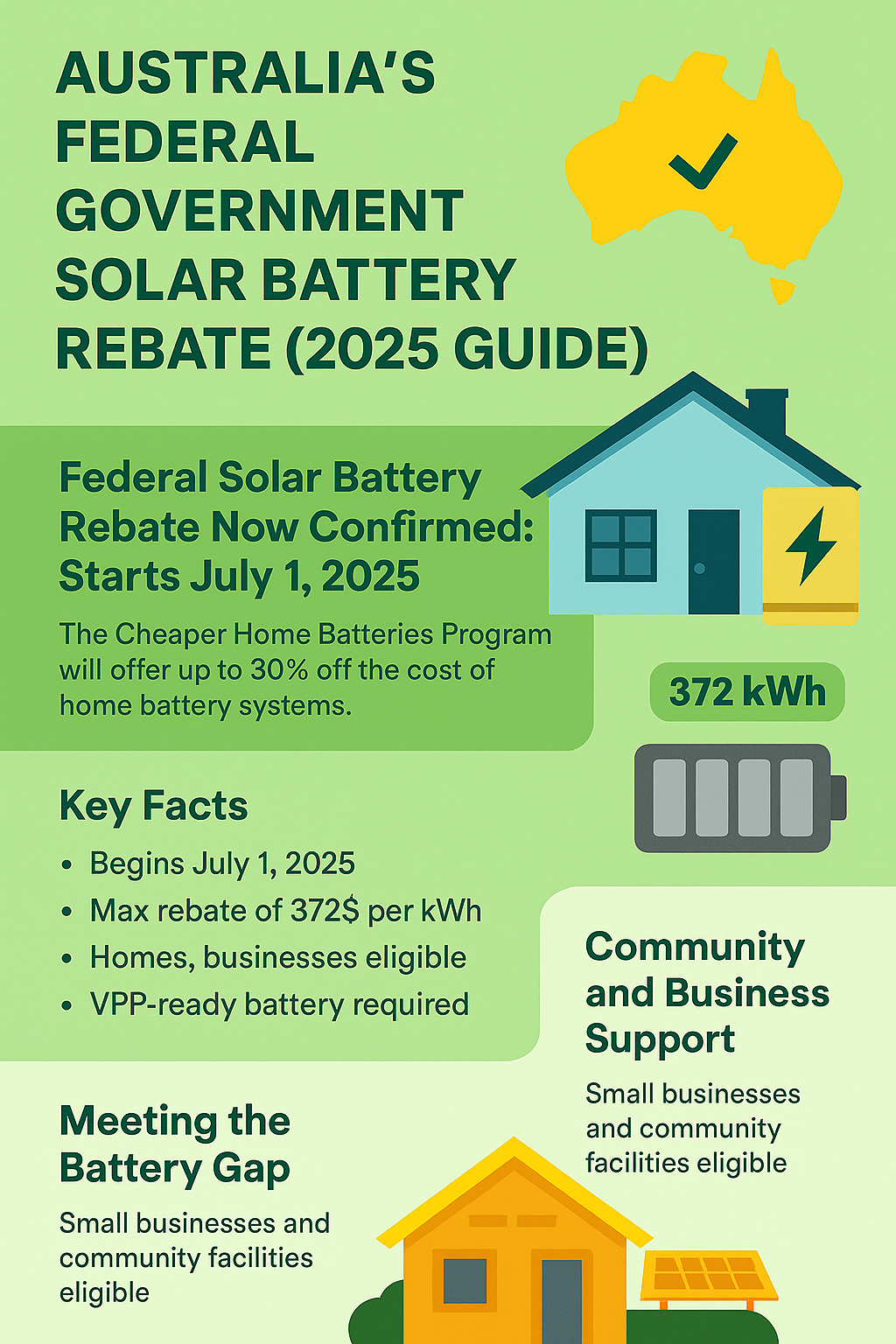
The Cheaper Home Batteries Program is a national solar battery subsidy that provides eligible homeowners, small businesses, and community organisations with an upfront discount of up to 30% off the cost of an approved home battery storage system. The discount is delivered as small-scale technology certificates calculated per usable kilowatt-hour, and the rate steps down on a schedule.
Updated 28 August 2026: the STC factor dropped from 8.4 to 6.8 on 1 May 2026, which works out at roughly $252 per usable kWh — about $2,520 on a 10 kWh battery. That is down from around $311 in early 2026 and $372 when the program launched in July 2025. Since 1 May 2026 the rate is also tiered: the first 14 kWh earns the full factor, 14–28 kWh earns 60% of it, and 28–50 kWh just 15%. The factor now steps down every six months through to the end of 2030, so always confirm the current rate before you budget.
The program is designed to make battery storage more financially viable and accessible. Until now, the upfront cost of batteries has been a significant barrier for many homeowners.
With prices ranging from $10,000 to $20,000 depending on the brand and capacity, battery systems were often considered a luxury add-on rather than a core part of a home's energy strategy. The rebate aims to shift that narrative.
Crucially, the rebate is not means-tested. It is available to all eligible property owners, whether they are homeowners, landlords, or business operators. This inclusive design ensures that a broader swathe of Australians can participate in the clean energy transition, regardless of income level.
Why This Matters: The Battery Gap
While Australia is a world leader in rooftop solar panel penetration, with over 4 million homes sporting solar panels, battery uptake remains modest. It's estimated that fewer than 1 in 40 solar homes have a battery installed. This gap represents a huge untapped potential.
Batteries allow households to store excess solar energy generated during the day and use it in the evening, when grid electricity is most expensive. This not only reduces reliance on the grid but also increases household energy independence and resilience.
By incentivising battery adoption, the government hopes to flatten peak demand curves, reduce pressure on ageing grid infrastructure, and help integrate more renewables into the national electricity market. It's a win for homeowners, a win for the energy grid, and a win for the planet.
How the Rebate Works
The rebate is administered under the SRES and functions through tradable certificates that reflect the battery's contribution to Australia's renewable energy targets. These certificates, known as Small-scale Technology Certificates (STCs), are generated upon installation.
Accredited installers then apply the value of these certificates as an upfront discount to customers. Consumers don't need to manage the paperwork.
Instead, Clean Energy Council (CEC) accredited installers handle the entire process. The rebate is automatically applied to the invoice, meaning households pay less upfront without needing to claim the discount later.
The program is uncapped, meaning there's no set limit on the number of households or businesses that can claim the subsidy. It will run from July 1, 2025, until the end of 2030, with the value of the rebate expected to decline annually in line with falling battery prices.
Eligibility Criteria
To qualify for the rebate, systems must:
- Be between 5 kWh and 50 kWh in usable capacity
- Be installed by a CEC-accredited installer
- Be new (not second-hand or refurbished)
- Be VPP-ready (Virtual Power Plant capable)
- Be installed alongside new or existing rooftop solar systems
The rebate applies to both on-grid and off-grid properties, as long as the system is technically capable of connecting to a VPP. Participation in a VPP is not mandatory, but the system must meet technical requirements for VPP readiness.
If you're a landlord with multiple properties, you can claim a rebate for each one individually. However, only one battery rebate can be claimed per property.
Timing and Pre-Installation
An important feature of the scheme is its allowance for systems installed before the official start date to still qualify. If a battery is installed before July 1, it can be eligible for the rebate—but it must remain switched off until the program begins.
This provision encourages early preparation and installation while still ensuring program compliance. For example, if you install a battery in May or June and keep it offline until July, you can still access the rebate.
This means households and businesses can avoid the expected installation bottleneck once the program formally launches.
What You Could Save
The financial savings under the Cheaper Home Batteries Program are compelling. Consider a mid-range system:
- At the current rate, a 10 kWh battery receives a rebate of approximately $2,520. On a $13,500 installed price that brings the net cost to around $11,000. (At the July 2025 launch rate the same battery attracted about $3,300 — a useful illustration of why waiting costs money.)
- Larger systems, such as a 13.5 kWh Tesla Powerwall 2, could attract a rebate of over $4,400.
When combined with state-based rebates, these savings become even more significant. For example, a Victorian household stacking the federal rebate with the state's interest-free battery loan could reduce the upfront cost by more than 40%.
Long-Term Energy Bill Reductions
Battery systems paired with rooftop solar panels allow households to use more of their self-generated power and reduce grid reliance. Depending on consumption patterns, households can reduce electricity bills by up to 90%.
A typical household with a solar-plus-battery system might save:
- $1,000 to $1,500 annually if they already have solar
- Up to $2,500 annually if installing both solar and battery at the same time
- Even more if participating in a Virtual Power Plant program that pays for exported stored energy
Over a 10-year period, that could represent $10,000 to $25,000 in total savings—not including the added resilience and peace of mind during outages.
For more information on the long-term benefits of solar, check out our detailed analysis on The Real ROI of Solar.
Combining With State Incentives
The federal rebate can be combined with state-level incentives, a practice commonly referred to as "stacking." Programs vary by state and may include upfront rebates, zero-interest loans, or time-of-use tariff benefits.
Some of the main state programs include:
- Victoria: Solar Homes battery interest-free loan
- South Australia: Switch for Solar and VPP pilot programs
- NSW: Empowering Homes battery program
- WA: Community Battery Scheme
By combining both tiers of incentives, homeowners can significantly reduce their out-of-pocket costs and improve the return on investment of their system.
What Does VPP-Ready Mean?
One of the key eligibility requirements is that the battery must be VPP-ready. A VPP, or Virtual Power Plant, is a cloud-based network that aggregates multiple home batteries into a single energy resource.
This combined system can then supply power to the grid during peak demand times or outages. Being VPP-ready doesn't require you to join a VPP, but your battery must be capable of being remotely managed and controlled by a VPP operator.
Many modern battery systems are already VPP-ready out of the box, including popular models from Tesla, Sungrow, and Alpha ESS.
Joining a VPP is optional but often recommended. Participants may receive additional credits for exported energy and gain access to exclusive tariff benefits. Some VPPs even offer performance-based payments or shared revenue schemes.
For a deeper exploration of battery technologies, see our Complete Guide to Solar Battery Storage.
Community and Business Benefits
The Cheaper Home Batteries Program extends beyond residential homes. Small businesses, community facilities, sports clubs, libraries, and local councils can also participate.
These groups often face higher daytime energy demands and stand to benefit substantially from solar battery systems. A typical small business could use a 30 to 50 kWh battery system to lower operational expenses, reduce exposure to rising electricity prices, and increase energy security during outages.
Community organisations can redirect savings to public services and improve sustainability credentials.
If you're interested in the specific benefits for businesses, our Commercial Solar Solutions page offers more detailed information.
Final Thoughts: Are Batteries Worth It Now?
In short: yes. The federal battery rebate removes one of the last major hurdles to mass battery adoption in Australia.
Combined with rising electricity prices, falling solar feed-in tariffs, and increasing system affordability, the rebate changes the game. Battery systems that once had decade-long payback periods are now reaching break-even in under 7 years for many households.
But more than just a financial calculation, batteries are about control, independence, and sustainability. They allow Australians to take ownership of their energy future—one kilowatt-hour at a time.
If you're considering installing a battery or solar-plus-battery system, now is the time to act. Delaying could mean missing out on optimal savings or facing long installer wait times once the program begins.
For those interested in complete energy independence, our guide on Off-Grid Living provides valuable insights.
At Keystones Energy Solutions, we're ready to help you navigate the process. Our experienced team can provide tailored advice, premium components, and seamless installations to ensure you get the best system for your needs—and qualify for the maximum rebate.
Get in touch with us today to arrange a free quote and take the first step toward energy freedom.
Don't forget to review our maintenance tips to ensure your system performs optimally for years to come.