
A lot of Sunshine Coast homes put solar on five or ten years ago, back when exporting your surplus paid reasonably well. Feed-in tariffs have since been cut, power prices haven't, and now the panels spend the middle of the day gifting energy to the grid for a few cents. A battery retrofit is the fix, and it's most of the battery work we do.
Can I add a battery to my existing solar system?
Yes. Almost every existing solar system can have a battery added, whatever brand of inverter is on the wall, and you almost never need to replace working panels. The main decision is whether the battery goes alongside your current inverter (AC-coupled) or whether the inverter gets replaced with a hybrid so panels and battery share it (DC-coupled). The federal battery rebate applies to retrofits too, as long as the battery is new, eligible and installed by a CEC-accredited installer.
What decides the details isn't the panels. It's the age and health of your inverter, your switchboard, where the battery can physically go, and what Energex allows at your address.
AC coupled vs DC coupled batteries
This is the one bit of jargon worth learning before you get quotes.
AC-coupled: keep your inverter
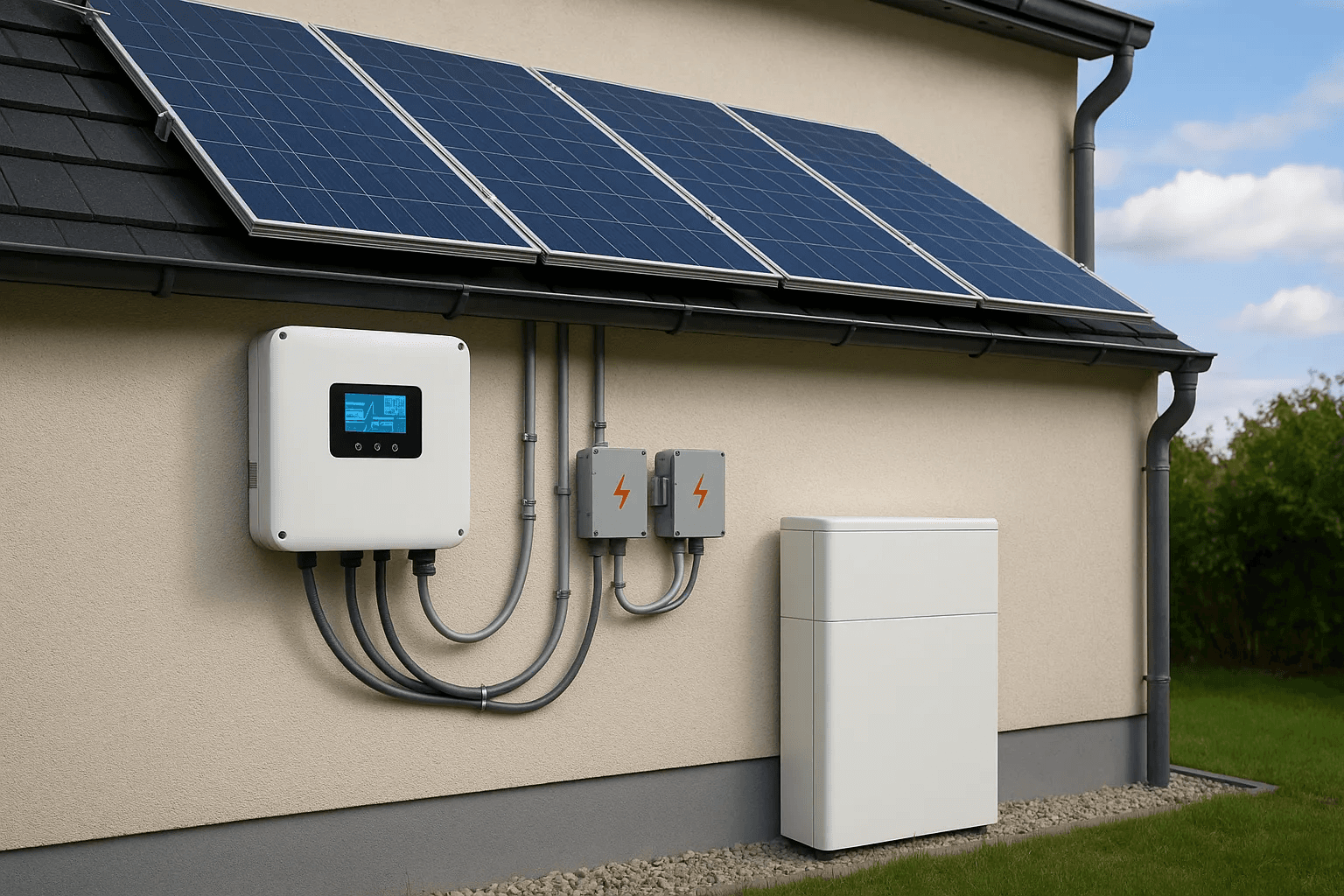
Your existing solar inverter stays exactly where it is. The battery gets its own inverter alongside it.
Solar power is converted from DC to AC by your existing inverter, as it always has been. When there's surplus, the battery inverter converts some of that AC back to DC to charge the battery, then back to AC again when the house needs it in the evening.
- Pros: works with almost any existing inverter brand, keeps your current system intact, keeps any legacy feed-in arrangement you're on, faster and less disruptive install.
- Cons: you lose a couple of per cent to the extra conversions, and you have two inverters (and often two apps) instead of one.
DC-coupled: one hybrid inverter
Your old inverter comes off and a hybrid inverter goes on. The panels and the battery both connect to it. Solar charges the battery directly as DC, without the extra AC round trip.
- Pros: more efficient, tidier, one warranty point of contact, one app, and a good chance to upgrade an ageing inverter.
- Cons: you're replacing an inverter, which only makes sense if yours is near the end of its life or you're changing the system anyway.
| AC-coupled retrofit | DC-coupled (hybrid) | |
|---|---|---|
| Existing inverter | Stays | Replaced with a hybrid |
| Efficiency | A couple of per cent lower (extra conversion) | Higher (solar charges battery directly) |
| Works with | Almost any existing inverter brand | New hybrid with matched battery |
| Disruption | Lower | Higher |
| Best when | Inverter is healthy and fairly new | Inverter is old, failing, or you're adding panels |
Should you keep your inverter or replace it?
Here's the rule of thumb we use on every retrofit:
- Existing inverter is healthy and under 8 years old → AC-coupled retrofit. Keep what works.
- Inverter is failing, out of warranty, or you're expanding the array → replace it with a hybrid and go DC-coupled.
- New solar and battery together → DC-coupled hybrid. Best efficiency, one warranty point of contact.
The middle one catches a lot of people. Inverters usually fail long before panels do, and plenty of systems from the 2011 to 2013 rebate wave are already on their second inverter or due one. If your inverter is approaching the end of its life, paying to AC-couple a battery to it and then replacing it two years later is paying twice. Doing the inverter and battery in one visit also avoids paying twice for the same switchboard and metering work.
We work with Fronius, Selectronic, SMA, Enphase and Deye inverters, so a retrofit is rarely blocked by what's on your wall.
A note on Enphase microinverters
If your solar runs on Enphase microinverters, the battery has to be AC-coupled, because there's no central DC point to connect a battery to. It works, but you're adding a second ecosystem. Staying inside the Enphase family can be the cleaner option; we'll talk you through both.
How much does it cost to add a battery to a solar system?
These are installed prices on the Sunshine Coast, as at August 2026, before the federal battery rebate:
| Battery size | Installed, before rebate |
|---|---|
| 5 kWh | $8,500–$9,500 |
| 10 kWh | $13,000–$14,500 |
| 15 kWh | $17,500–$19,500 |
Switchboard upgrades and cable runs are the main things that move a job from the bottom to the top of the band. If the retrofit includes replacing your inverter with a hybrid, that's priced on top.
How the federal battery rebate applies to a retrofit
The federal Cheaper Home Batteries Program launched on 1 July 2025 and takes up to around 30 per cent off an approved 5 to 50 kWh battery. It's applied upfront by your installer as a discount on the invoice, not claimed later.
- Retrofits qualify. The battery can go onto an existing rooftop solar system.
- Since 1 May 2026, it's worth roughly $252 per usable kWh (down from around $311 earlier in 2026). A 10 kWh battery attracts about $2,520.
- It's tiered. The first 14 kWh earns the full rate, 14 to 28 kWh earns 60 per cent of it, and 28 to 50 kWh earns 15 per cent.
- It steps down every six months through to the end of 2030, so the rate that counts is the one current on your install date.
- Eligibility: the battery must be new, VPP-ready (able to join a Virtual Power Plant; you don't have to), and installed by a CEC-accredited installer. One rebate per property. Not means-tested.
So on the current rate, a 10 kWh retrofit at $13,000 to $14,500 comes to roughly $10,480 to $11,980 after the rebate. We confirm the exact rebate in writing on every quote. The full rules are on our Queensland solar and battery rebate page, and we break pricing down further in our guide to solar battery cost on the Sunshine Coast.
Is a battery retrofit worth it?
A typical Sunshine Coast home with solar only uses 30 to 50 per cent of what its panels make. The rest goes to the grid at a feed-in rate commonly around 3 to 12 cents per kWh, then gets bought back after dark at roughly 25 to 35 cents. A well-sized battery lifts self-consumption to around 80 to 90 per cent.
That's where the savings come from. For most retrofit customers we model $1,000 to $1,500 a year, and battery payback typically lands around 7 to 12 years, or 6 to 8 years for households with heavy evening loads like air conditioning, pool pumps or EV charging. The rebate takes two to three years off that. Anyone promising a guaranteed three-year payback is selling, not calculating.
Before you retrofit: what we check
A phone estimate can't see these, which is why we do a site visit:
- Your inverter. Make, model, age, health, and whether it's still supported.
- Your array size. A battery needs surplus solar to fill it. There's no point buying 20 kWh of storage if your array only has 10 kWh of surplus on a good day. On a small, older system, adding panels can pay back faster than adding battery capacity.
- Your switchboard. Capacity, condition and space for new protection.
- The battery location. Out of direct afternoon sun, compliant with the battery installation standard (AS/NZS 5139), with clearances from doors, windows and habitable rooms.
- Your network connection. Energex requires a connection application before a battery is installed, and the export rules at your address affect the design.
- Your feed-in tariff. If you're still on the legacy Queensland Solar Bonus Scheme or another older, higher rate, tell us before anything changes on your system.
How big should the battery be?
Size it from your evening and overnight use, roughly 4pm to 7am, not your daily total. For most Sunshine Coast homes that's 8 to 16 kWh, which is why 10 kWh and 15 kWh are the two sizes we quote most. Oversizing is the most common mistake we see on other quotes. If you're wondering how far a given size will stretch, see how long a 10kWh battery lasts.
Will a retrofit battery work in a blackout?
Only if it's specified and wired for backup. Not every battery install includes it, which catches people out. A standard grid-connected solar system shuts down when the grid does; that's a safety requirement. A battery with backup isolates the house, forms its own little grid and keeps your nominated circuits running, and your solar keeps recharging it during the day.
Most people back up an essential-loads circuit: fridge, lights, power points, internet. Whole-home backup is possible but needs more inverter capacity and costs more. If backup matters to you, say so at the quote stage.
Our solar battery installation page covers the brands we fit, sizing and the retrofit process. We're also happy to work on systems another company installed.
Frequently asked questions
Can I add a battery to my existing solar system?
Yes, in almost every case. An AC-coupled battery works alongside your existing inverter regardless of brand, so the panels and inverter stay put. If your inverter is old or failing, replacing it with a hybrid and DC-coupling the battery is usually better value. Feasibility comes down to switchboard capacity, a suitable battery location and the Energex rules at your address.
How much does it cost to add a battery to a solar system?
On the Sunshine Coast, as at August 2026, a battery retrofit costs around $8,500 to $9,500 for 5 kWh, $13,000 to $14,500 for 10 kWh and $17,500 to $19,500 for 15 kWh, installed and before the federal rebate. The rebate is roughly $252 per usable kWh since 1 May 2026, or about $2,520 on a 10 kWh battery. Replacing the inverter with a hybrid is extra.
Does the federal battery rebate apply to retrofits?
Yes. The Cheaper Home Batteries Program covers batteries added to existing rooftop solar, provided the battery is new, 5 to 50 kWh usable, VPP-ready and installed by a CEC-accredited installer. It's deducted from your invoice upfront, and you can claim one per property.
Should I get an AC coupled or DC coupled battery?
If your inverter is healthy and under about 8 years old, AC-coupled is usually the sensible retrofit. If your inverter is failing, out of warranty, or you're adding panels, go DC-coupled with a new hybrid inverter. For new solar and battery together, DC-coupled is the better design.
Will adding a battery affect my feed-in tariff?
It can, depending on how the system is changed and what arrangement you're on. An AC-coupled retrofit leaves your existing solar untouched, which helps keep legacy arrangements. If you're on an older, higher feed-in rate, tell your installer before anything changes so it can be checked.