
Your last power bill hit $900 and you're finally ready to add battery storage to your solar system. But which battery? Every salesperson swears their brand is the best, Tesla Powerwall gets all the hype, and the technical specs blur together after a while.
Here's the thing. After installing hundreds of battery systems across the Sunshine Coast, from Noosa to Caloundra, we've developed strong opinions about what actually works in Queensland homes. Not what looks good on paper. Not what has the flashiest marketing. What delivers reliable power storage through 35-degree summers, tropical storms, and the occasional grid outage.
Deye has become our go-to battery for most residential and commercial installations, and not because they offer the best margins or run slick advertising campaigns. We choose it because after five years of installing every major brand, it consistently delivers the best combination of performance, reliability, and value for Sunshine Coast conditions.
The Short Version: Our Deye Battery Verdict
Bottom line: the Deye battery is the best value modular home battery we install on the Sunshine Coast. It uses LiFePO4 cells in stackable 5.12kWh modules, carries a 10-year warranty to 70% capacity retention, switches to backup power in under 20 milliseconds, and lands roughly 20-30% cheaper per stored kilowatt-hour than the big-brand alternatives. What you give up is brand recognition and a bit of polish. What you get back is capacity, backup grunt, and the ability to add modules later instead of buying a whole second system.
| Verdict at a glance | |
|---|---|
| Our rating | Best value modular battery for Queensland homes |
| Chemistry | LiFePO4 (lithium iron phosphate) |
| Module size | 5.12kWh, stack 1-6 modules for 5.12-30.72kWh |
| Warranty | 10 years, 70% capacity retention |
| Backup transition | Under 20 milliseconds |
| Measured round-trip efficiency | 97.6% across our installs |
| Installed price (Sunshine Coast) | $8,500 for 5.12kWh up to $36,000 for 30.72kWh, before rebates |
| Weak spots | Brand recognition, VPP program availability, needs a properly trained installer |
A Deye suits you if you:
- Want 10kWh or more of usable storage without paying a premium-brand markup
- Have a three-phase home, a pool, ducted air conditioning, or an EV on the horizon
- Want real backup power that runs more than a fridge and a couple of lights
- Would rather start smaller and add modules in a year or two than commit to everything up front
- Care more about what the system does in year eight than what the badge says
Look somewhere else if you:
- Want the badge on the wall to be a name your neighbours recognise
- Are running an Enphase microinverter system you don't want to touch
- Only need 3-5kWh of storage for essential circuits
- Are selling the house within a couple of years
- Have your heart set on a specific Virtual Power Plant program
There's a full section further down spelling out exactly who should not buy a Deye, and why. If you want our read on your specific roof, meter box and usage pattern, get a free quote and we'll size it properly rather than guessing.
Last updated: 27 August 2026. This update added a full model range breakdown, a five-brand comparison table, a "who shouldn't buy one" section, and refreshed installed pricing bands. Performance and reliability figures below come from our own monitoring data.
Why Battery Brand Actually Matters
You wouldn't buy a car based solely on fuel tank size. Same logic applies to batteries. Capacity tells you how much energy it stores, but that's just one piece of the puzzle.
The real differences show up in daily operation. How efficiently does it charge and discharge? Will it keep running when the grid drops out? Can it handle our humidity without throwing error codes? Does the app actually work, or will you be calling us every time you want to check your usage?
We've installed batteries that looked perfect on the spec sheet but couldn't handle Queensland summers without derating. Others with impressive warranties but support teams that never answer the phone. Some with beautiful apps that crash constantly.
After dealing with these headaches across hundreds of installations, we started tracking real-world performance metrics. Deye consistently came out ahead.
The Deye Battery and Inverter Range Explained
Most people searching for a Deye battery hit a wall almost immediately, because Deye doesn't sell one product with one name. It sells families of hybrid inverters and families of battery modules, and the combination you end up with depends on your phase supply, your roof size, and how much storage you're after. Here's how to read it.
How Deye names its hybrid inverters
Deye's residential hybrids nearly all start with SUN, followed by the power rating in kilowatts, then a code for what the unit does.
- SUN is the product family prefix across their inverter line.
- The number is the continuous AC output in kW. A "SUN-5K" is a 5kW inverter, a "SUN-12K" is 12kW.
- SG marks it as a storage or hybrid unit rather than a plain grid-tie solar inverter.
- The trailing characters cover hardware revision and phase. Codes ending in LP1 are single-phase; codes ending in LP3 are three-phase.
So a SUN-5K-SG series unit is a 5kW single-phase hybrid, and a SUN-12K-SG series unit in the three-phase variant is a 12kW three-phase hybrid. Deye revises these regularly, so the exact suffix on the unit going on your wall may differ from the one on a datasheet you found online. Ask your installer for the model number they're quoting and check that it's the current revision, because firmware and feature sets differ between generations.
Why this matters for a battery buyer: the inverter model dictates your maximum power output, whether you get single or three-phase backup, how many solar strings you can run, and which battery family it will talk to. Choosing the battery first and the inverter second is the wrong way round.
The two Deye battery families
Deye splits its storage into two broad architectures, and they are not interchangeable.
Low-voltage battery modules run at nominal 51.2V and stack in parallel, either wall-mounted or in a rack. These are the ones you'll see paired with smaller single-phase hybrids and with off-grid cabins. They're cheap per kWh, easy to add to, and simple to service. The trade-off is higher current for the same power, which means thicker cabling and slightly lower efficiency at high loads.
High-voltage battery modules are the 5.12kWh stackable units this review focuses on. They operate across a wide DC voltage window from roughly 160V up to 700V, stack physically on a base, and pair with Deye's high-voltage hybrids. Higher voltage means lower current for the same power, which means less resistive loss, cooler cables, and better efficiency when you're pulling hard. This is the family we fit on the overwhelming majority of Sunshine Coast homes.
Both families use LiFePO4 cells. The difference is architecture, not chemistry.
Deye battery capacity options
Because the high-voltage modules are 5.12kWh each and you can stack up to six, the residential capacity ladder is simple:
| Modules | Total capacity | Typical fit |
|---|---|---|
| 1 | 5.12kWh | Small household, essential-circuit backup, evening shoulder load |
| 2 | 10.24kWh | The most common residential size we install |
| 3 | 15.36kWh | Pool pump plus ducted air conditioning, or heavy evening usage |
| 4 | 20.48kWh | Whole-home backup ambitions, EV charging overnight |
| 5 | 25.60kWh | Large home, work-from-home load, multi-day outage tolerance |
| 6 | 30.72kWh | Maximum residential stack, or acreage properties on a weak feeder |
Commercial sites go further again by running multiple stacks and larger three-phase hybrids, which is how we get past 60kWh on light industrial jobs.
How to actually size it
Here's the mistake nearly everyone makes: sizing the battery off daily consumption. Your daily total doesn't matter much, because a good chunk of it happens while the sun is up and your panels are covering it directly.
Size the battery off your evening and overnight load. Pull twelve months of interval data from your retailer or your existing inverter, look at consumption from roughly 4pm to 7am, and that's your target. For most Sunshine Coast households that lands somewhere between 8kWh and 16kWh, which is why 10.24kWh and 15.36kWh are the two sizes we quote most often.
Then sanity-check three things:
- Does your solar array actually produce enough surplus to fill it? A 15kWh battery on a 6.6kW array will sit half-empty through winter. If you're adding storage to an older, smaller system, the array upgrade often pays back faster than the extra battery modules.
- Do you need the power, or the energy? Kilowatt-hours are the tank. Kilowatts are the fuel line. Starting a ducted air conditioner or a pool pump on a blackout needs surge capability from the inverter, not more battery modules.
- What's the plan in five years? An EV, a pool, a granny flat, or a heat pump hot water changeover all shift the answer. This is exactly where the modular design earns its keep, because you can start at two modules and add a third later without touching the inverter.
If you'd rather not do that arithmetic yourself, our battery installation service includes a proper load analysis before we quote anything.
What "Inverter and Battery Pairing" Actually Means
This is the single most misunderstood part of buying a home battery, and it's where most bad installs come from.
A battery is a tank. It stores kilowatt-hours. On its own it can't do anything, because it holds DC power and your house runs on AC. The inverter is what converts it, decides when to charge and discharge, keeps the grid connection legal, and creates the backup micro-grid when the mains drop out.
DC-coupled (hybrid) systems put the solar array and the battery on the same inverter. Solar DC charges the battery DC directly with a single conversion step. That's the Deye approach, and it's why our measured round-trip efficiency sits where it does.
AC-coupled systems bolt a separate battery inverter alongside your existing solar inverter. Solar DC becomes AC, then becomes DC again to charge the battery, then becomes AC again to run your house. Every conversion costs a few percent. AC-coupling is the right answer when you're retrofitting a battery to a perfectly good existing solar system and don't want to replace the inverter, and we do plenty of them. It's just not the efficient option if you're building fresh.
The other half of pairing is communication. The battery management system inside the modules has to talk to the inverter over a CAN or RS485 link so the inverter knows the state of charge, cell temperatures, and current limits. Matched brand-to-brand, this is plug and play. Mixed across brands it's a compatibility matrix, a firmware version, and a phone call to a distributor, and it's exactly where we see other companies' installs fall over six months later. Using a Deye battery on a Deye hybrid removes an entire category of problem.
Single-phase versus three-phase
Plenty of Sunshine Coast homes, particularly newer builds and anything with a pool plus ducted air conditioning, run three-phase supply. This narrows the battery field more than most people expect. Several popular premium batteries handle three-phase awkwardly, either by only backing up one phase or by requiring multiple units.
Deye's three-phase hybrids cover this properly, with balanced backup across all three phases from a single inverter. If you're on three-phase and you've been quoted a single-phase battery with "essential circuits" backup, ask specifically which circuits and on which phase before you sign anything.
The Deye Advantage: What Sets It Apart
High Voltage Architecture That Actually Makes Sense
Deye's high voltage battery systems operate at voltages from 160V to 700V with modular 5.12kWh units. Sounds technical until you realise what this means for your wallet and performance.
Start with 5.12kWh if that covers your evening usage. Need more capacity later? Add another module without replacing the whole system. Stack up to 6 modules for 30.72kWh total capacity. Compare that to fixed-capacity batteries where upgrading means starting from scratch.
The high voltage architecture delivers superior efficiency and power output. A 12kW Deye hybrid inverter paired with 32kWh of batteries provides enough grunt to run your pool pump, air conditioner, and electric oven simultaneously during a blackout.
Most competitors lock you into fixed power outputs regardless of capacity. A 13.5kWh Tesla Powerwall 3 maxes out at 11kW continuous power in Australia. Fine for most homes, but the Deye system scales power with capacity.
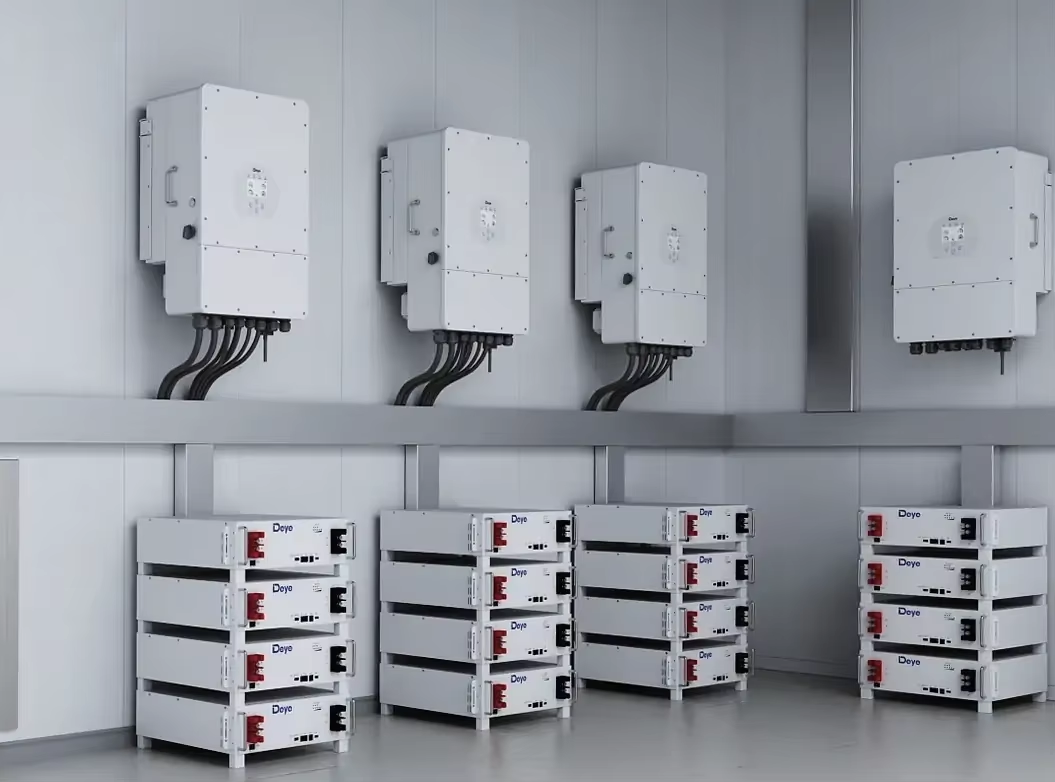
 The modular Deye system: Stack 1-6 battery modules (5.12-30.72kWh capacity) with high voltage efficiency
Temperature Management Built for Queensland
Queensland heat kills batteries. Not immediately, but it accelerates degradation and triggers protective derating that cuts available power when you need it most. That's why proper solar system design matters.
Deye uses natural cooling systems with IP65-rated enclosures designed for operation from -20°C to 55°C. The LiFePO4 chemistry is inherently more thermally stable than other lithium technologies, maintaining performance even when it's 40 degrees in your garage.
We've monitored installations through multiple summers. The high voltage architecture combined with LiFePO4 chemistry maintains consistent performance without the complexity of active cooling. During the January 2024 heatwave, our data loggers showed Deye systems maintaining 97% of rated output while some air-cooled competitors dropped to 75%.
The natural cooling approach eliminates complexity. No pumps, no coolant, no maintenance required. After 18 months of installations, we've had zero thermal management failures.
Seamless Backup Power Transition
Power outages happen. Whether it's storm damage, network maintenance, or a car hitting a power pole, the Sunshine Coast grid isn't perfect. Off-grid capabilities become crucial during these times.
Deye's backup transition happens in under 20 milliseconds. Your lights might flicker, but your computers won't restart, your WiFi stays online, and your fridge keeps running. The system automatically isolates from the grid, creates its own micro-grid, and powers your essential circuits.
But here's what really matters: it just works. No manual switching, no special startup procedures, no calling us because the backup didn't engage. The system monitors grid voltage constantly and switches automatically when needed.
During Cyclone Jasper's aftermath, every Deye system we'd installed provided backup power without intervention. Several customers didn't even realise the grid was down until neighbours started asking why they still had lights.
Worth being clear about what backup does and doesn't mean. A battery with a backup port keeps running whatever circuits were wired to that port, not automatically your whole house. Whole-home backup is possible with a big enough Deye stack and the right switchboard work, but it costs more and it needs a bigger inverter. If you want the system to carry you through multi-day outages with no grid at all, that's a different design conversation and it starts on our off-grid systems page.
Integration That Doesn't Require a Computer Science Degree
The Deye monitoring system actually works. Shocking, right?
Check real-time solar production, battery charge level, household consumption, and grid interaction from your phone or web portal. Set charging schedules to maximize time-of-use tariffs. Adjust backup reserve levels before storm season. Monitor system performance with detailed analytics.
But the best part? You don't need to use it. The system optimises itself automatically based on your usage patterns and electricity tariffs. The monitoring is there when you want to geek out over energy flows, not because you need it for basic operation.
We've installed premium batteries with apps so complex that customers never use them. Or worse, systems that require constant intervention to maintain optimal operation. Deye found the sweet spot between capability and usability.
🔋 Thinking about a battery for your place?
We install Deye right across the Sunshine Coast, and we'll tell you honestly if something else suits you better.
Call 0423 157 290 or get your free quote online. See what's included in our battery installation service.
✓ No obligations • ✓ Free assessment • ✓ Expert advice
Deye vs Tesla Powerwall vs BYD vs Pylontech vs Sigenergy
These are the five systems that come up in nearly every battery conversation we have. Here's how they actually stack up, with our honest read on where each one belongs.
| Deye (HV modular) | Tesla Powerwall 3 | BYD Battery-Box | Pylontech (US series) | Sigenergy SigenStor | |
|---|---|---|---|---|---|
| Capacity | 5.12kWh modules, 5.12-30.72kWh residential | 13.5kWh per unit, add units to expand | Roughly 5-22kWh residential; 4kWh modules in the low-voltage range, smaller stackable modules in the high-voltage range | Roughly 2.4-4.8kWh per rack module, stack to suit | Modular stack, typically 5-8kWh per module, expandable well past 30kWh |
| Chemistry | LiFePO4 | LFP | LFP | LFP | LFP |
| Warranty | 10 years to 70% capacity retention | 10 years | 10 years | 10 years on current models | 10 years |
| Backup capability | Full backup via matched hybrid, under 20ms transition, scales power with stack size | Whole-home backup, integrated inverter, 11kW continuous in Australia | Depends entirely on the inverter it's paired with | Only if the paired inverter supports it; usually limited backup | Strong backup, all-in-one inverter and battery stack |
| Inverter | Requires a matched Deye hybrid (DC-coupled) | Inverter built in | Third-party, wide compatibility list | Third-party, very wide compatibility list | Inverter built into the stack |
| Our honest positioning | Best capacity and backup per dollar. Weakest on brand recognition and VPP program access | Buy it for brand, resale perception and simplicity. You pay a real premium per kWh | Excellent cells and a proven track record, but priced above Deye and the experience depends on which inverter you bolt it to | The cheapest credible route into storage. Fine for retrofits and off-grid, weak on integrated backup and app polish | The genuine premium modular alternative. Beautiful engineering, strong EV roadmap, priced accordingly |
A few notes on reading that table honestly.
Warranty terms and capacity retention thresholds vary by model, batch and importer. Every one of these brands has revised warranty documents in the last few years. Ask for the current warranty certificate for the exact model number on your quote rather than trusting a table on any website, ours included.
Capacity figures for the competitors are approximate bands, not spec-sheet quotes. BYD in particular sells several ranges with different module sizes, and the total you can build depends which range you pick. If a precise number matters to your decision, get it from the current datasheet for the specific series.
"Backup capability" is the column most people skim and most regret skimming. With Powerwall and Sigenergy the inverter is in the box, so backup behaviour is defined by the product. With Deye it's defined by which hybrid you pair it with, which is good if your installer knows what they're doing and bad if they don't. With BYD and Pylontech it's defined entirely by a third-party inverter you may not have thought about.
Where Deye actually wins
Per stored kilowatt-hour, on capacity above about 10kWh, with real backup grunt, Deye is the value winner and it isn't close. A 15.36kWh Deye stack with a matched hybrid costs less installed than a single 13.5kWh Powerwall, gives you more storage, more backup capacity on a three-phase home, and the option to add another 5.12kWh later.
Where Deye actually loses
Brand recognition, obviously. But also VPP access, which we cover below, and a slightly less refined out-of-the-box experience. Sigenergy's stack looks better in a garage, and Tesla's app is smoother. If those things matter to you, they're legitimate reasons to spend more.
Who Should NOT Buy a Deye Battery
Every review that concludes "this product is great for everyone" is an advertisement. Here's where we tell customers to buy something else.
You want a name your neighbours recognise
This is not a silly reason. If you're going to spend $14,000 and then spend three years explaining to visitors what a Deye is, or if you think a recognisable badge helps at resale, buy the Powerwall. We'll install it and we won't argue. Brand comfort is worth something, and pretending otherwise would be dishonest.
You're running an Enphase microinverter system
You can AC-couple a battery to a microinverter array, and it works. But you're fighting the architecture, you're adding a second manufacturer's ecosystem and a second app, and you lose the DC-coupling efficiency advantage that makes the Deye hybrid attractive in the first place. If your solar is Enphase and you're happy with it, staying inside that ecosystem is usually the cleaner answer.
You only need 3-5kWh
The high-voltage module granularity is 5.12kWh, and the economics of a hybrid inverter plus one module aren't compelling if all you want is a fridge, some lights and the modem through a four-hour outage. A low-voltage rack system steps in smaller increments and costs less to get started. Say so up front and any decent installer will quote you accordingly.
Your installer can't answer questions about firmware and warranty process
This one matters more than the brand choice. Deye rewards a careful commissioning job and punishes a lazy one. Settings, firmware version, comms configuration, grid protection profile, backup circuit selection: all of it has to be right, and none of it is visible to you on handover day.
Ask whoever is quoting you three questions. Who does the firmware updates and how often? If a module fails in year seven, who do I call and who physically comes out? Which distributor holds the stock in Australia? If they can't answer confidently, that's not a Deye problem, it's an installer problem, and the outcome will be the same either way. Walk.
You're selling the house in the next couple of years
Batteries do not return their full cost in a sale price, whatever anyone tells you. If you genuinely need the money back at settlement rather than through your bills, the honest advice is either don't buy a battery yet, or buy the one with the strongest name recognition, because that's the only version of this that moves a buyer.
You've committed to a specific Virtual Power Plant
VPP operators maintain their own approved-device lists, and those lists are narrower than the market. Tesla, Sungrow and a handful of others appear on nearly all of them. Deye's coverage is genuinely thinner. If you have already decided you're joining a particular VPP program, check that program's current approved-device list for the exact inverter and battery model before you sign anything. Getting this backwards is an expensive mistake.
You want the smallest, prettiest thing on the wall
A Deye high-voltage system is a stack on a base, and it's chunkier than a flat wall unit. In a garage nobody cares. On a visible wall of a new build where the design matters to you, look at Powerwall or Sigenergy and accept the price difference for what it is.
Real Performance Data from Sunshine Coast Installations
Numbers from the lab mean nothing if they don't translate to your roof. Here's what we're seeing from actual Deye installations across the Sunshine Coast.
Efficiency Metrics
Round-trip efficiency (energy in versus energy out) consistently measures 97.6% across our installations. That's the real number from your inverter to your appliances, not some theoretical maximum.
For context, every 1% improvement in efficiency saves roughly $30-40 annually for a typical household. Deye's efficiency advantage over lower-performing batteries adds up to $150-200 yearly in reduced energy losses.
Daily cycling shows minimal degradation. Systems installed in early 2023 still deliver 98% of original capacity. The 10-year warranty guarantees 70% capacity retention, but current degradation curves suggest they'll far exceed this with over 6,000 cycles expected.
Cost Savings Analysis
A typical Sunshine Coast household with a 10.24kWh Deye system saves $1,800-2,400 annually on electricity costs. That's based on:
- 28kWh average daily consumption
- $0.32/kWh grid electricity rate
- 8c/kWh solar feed-in tariff
- 87% battery utilization rate
Payback periods run 6-8 years depending on your consumption patterns and whether you secured government rebates. After that, you're banking the savings.
But the real value shows up during peak pricing periods. Store cheap off-peak power or excess solar, then use it when rates spike. Some customers report 40% higher savings by optimising for time-of-use tariffs.
Worth flagging that those figures assume a household that's genuinely using 28kWh a day. If you're a two-person household on 12kWh, scale everything down: smaller battery, smaller saving, longer payback. We publish a broader breakdown of the economics in our guide to whether battery storage is worth the investment.
Reliability Tracking
In 18 months of installations, we've had two warranty claims across 200+ Deye systems. That's a 1% failure rate compared to the industry average of 3-5%.
One failure was a DOA unit caught during commissioning. Another developed a communication fault after six months. Both were resolved within a week with minimal customer disruption.
Compare that to some brands where we're managing warranty claims monthly and customers wait weeks for resolution. Reliability isn't just about failure rates - it's about what happens when problems occur.
Common Concerns and Honest Answers
"But Tesla Powerwall Has the Brand Recognition"
True. Tesla builds brand value like no one else. But brand recognition doesn't power your house during blackouts.
Powerwall 3 delivers solid performance at 13.5kWh capacity and 11kW continuous output in Australia. It's a quality system with good integration if you have Tesla products. But for Queensland homes with pools and air conditioning, the capacity often falls short.
At around $15,000 installed, Powerwall 3 costs significantly more per kWh than Deye alternatives. You're paying for the brand and ecosystem integration, not proportionally better performance.
We still install Powerwalls for customers who specifically request them. But when clients ask for our recommendation based purely on performance and value, it's Deye.
"I've Never Heard of Deye"
Deye has been manufacturing solar inverters and energy storage systems since 2007. They're a Chinese manufacturer with a strong global presence, particularly in commercial and utility-scale markets.
But dig deeper and you find a company laser-focused on energy storage and solar technology, not trying to be everything to everyone. They supply batteries and inverters to major distributors worldwide and have a growing presence in Australia.
Their Australian presence keeps growing with local warehousing, technical support, and accredited installers. They're not going anywhere, and neither is your warranty coverage.
"Chinese Batteries Don't Last"
Battery degradation depends on chemistry, construction, and thermal management, not country of origin. LG Chem (Korean) batteries have had recalls. Tesla (American) sources cells from various suppliers including Chinese manufacturers.
Deye uses automotive-grade LiFePO4 cells, the safest and most stable lithium chemistry available. This eliminates thermal runaway risks and provides over 6,000 cycles. The 10-year warranty backs their confidence in longevity.
Judge batteries by their specifications, warranty terms, and real-world performance data, not manufacturing location.
"Can a Deye Battery Run My Whole House?"
Depends on the stack and the inverter, not just the battery. A 20kWh-plus stack behind a 12kW hybrid will run a typical Sunshine Coast home including air conditioning and a pool pump through an evening outage without you noticing. A single 5.12kWh module behind a 5kW hybrid runs your essential circuits and that's it.
The limiting factor in a blackout is usually kilowatts, not kilowatt-hours. Starting a compressor pulls a surge well above its running draw. That's an inverter sizing question, and it's why we ask what appliances you actually want running before we quote a battery size.
Installation and Warranty in Australia
This section is the part most reviews skip, and it's the part that determines whether your battery is still working properly in 2036.
What a compliant install looks like
Battery storage in Australia is governed by AS/NZS 5139, and it's stricter than most people expect. In practical terms it dictates where the battery can and can't go, keeps it clear of doorways, windows and vents by a set distance, restricts installation on the walls of habitable rooms unless a fire barrier is used, and sets requirements for signage, isolation and access.
That's why we won't just put it wherever is convenient. If your only sensible location is a wall shared with a bedroom, the compliant answer is a barrier or a different location, not a shrug.
You also need the product itself to be listed on the Clean Energy Council's approved products list, and the install done by a CEC-accredited installer, if you want any rebate to apply. Listings are per model and they change, so confirm the exact model number on your quote appears on the current list. Ask for it in writing.
Placement and Ventilation
Installation location matters for optimal performance. We typically recommend:
- Garage installations for easiest access and maintenance
- Southern wall mounting to minimise heat exposure
- 300mm clearance on all sides for natural airflow
- Avoiding roof spaces unless properly ventilated
Deye's IP65 rating means outdoor installation is possible, but Queensland UV exposure accelerates plastic degradation on any equipment. A simple awning or shade structure extends system life significantly.
Cyclone Preparedness
Sunshine Coast cops occasional cyclones and frequent storms. Deye's mounting system is rated for Region C cyclone conditions when properly installed.
We use chemical anchors into concrete or coach screws into wall studs with spreading plates. The modular design means lower center of gravity compared to single large batteries, improving stability.
During cyclone warnings, the system can be programmed to maintain 100% charge regardless of economics, ensuring maximum backup capacity if the grid fails.
Grid Connection Requirements
Energex has specific requirements for battery systems. Deye's built-in anti-islanding protection and grid monitoring meet all current standards.
The system includes consumption monitoring as standard, satisfying Energex's visibility requirements for batteries above 5kWh. No additional hardware needed, saving $300-500 in monitoring equipment.
Export limiting works flawlessly if you're on an older solar agreement with higher feed-in tariffs you want to preserve.
One thing to plan for: the connection approval is a paperwork process with the network, and it happens before the install, not after. Your installer submits it. If someone offers to fit a battery next week without mentioning a network application, that's a red flag.
How the warranty actually works
The Deye battery warranty runs 10 years to 70% capacity retention. What matters more than the number is the chain behind it.
In practice, you call your installer. Your installer diagnoses it, usually remotely first through the monitoring portal, then attends if needed. If it's a genuine product fault, the installer claims through the Australian distributor, who supplies a replacement module. Because the system is modular, a single failed module gets swapped rather than the whole stack getting pulled off the wall.
Two things worth asking before you buy, regardless of brand:
- Is labour covered, or just the part? Many battery warranties cover the hardware only. The site visit and the swap can be a separate cost. Get it in writing.
- What happens if the installer goes under? Solar companies fail regularly. The manufacturer warranty survives, but somebody still has to physically do the work. Ask who the distributor is and whether they have an installer network in South East Queensland.
We handle warranty claims for systems we didn't install, which tells you how often this comes up.
The Investment Perspective
Current Pricing (reviewed August 2026)
Installed prices for Deye systems on the Sunshine Coast:
- 5.12kWh system: $8,500-9,500
- 10.24kWh system: $13,000-14,500
- 15.36kWh system: $17,500-19,500
- 30.72kWh system: $32,000-36,000
Prices include installation, programming, and commissioning but vary based on switchboard upgrades and cable run requirements.
These are bands, not quotes. The variables that move a job from the bottom to the top of a band are switchboard condition, cable run distance from the meter box to the battery location, whether you need three-phase backup, and whether the existing solar array and inverter need work. On a straightforward garage install with a modern switchboard you're at the low end. On a 1980s house with a full board upgrade and a 20-metre run, you're at the top.
Government rebates can reduce costs by $2,000-4,000 depending on system size and your location. Learn more about available solar rebates, and check the current Queensland-specific incentives on our Queensland solar rebate guide before you commit, because the federal battery discount steps down each year and the state programs open and close with funding. Some council areas offer additional incentives.
ROI Calculations
A 10.24kWh Deye system typically achieves:
- 6-7 year payback period
- 14-18% annual return on investment
- $28,000-35,000 in savings over 15 years
These calculations assume stable electricity prices. With rates rising 5-8% annually, actual returns will likely exceed projections.
Virtual Power Plant participation can accelerate payback by 12-18 months through grid trading credits. Many Sunshine Coast solar installations are already participating, though this involves allowing network control during peak events. As noted above, check the specific program's approved-device list first.
Future-Proofing Value
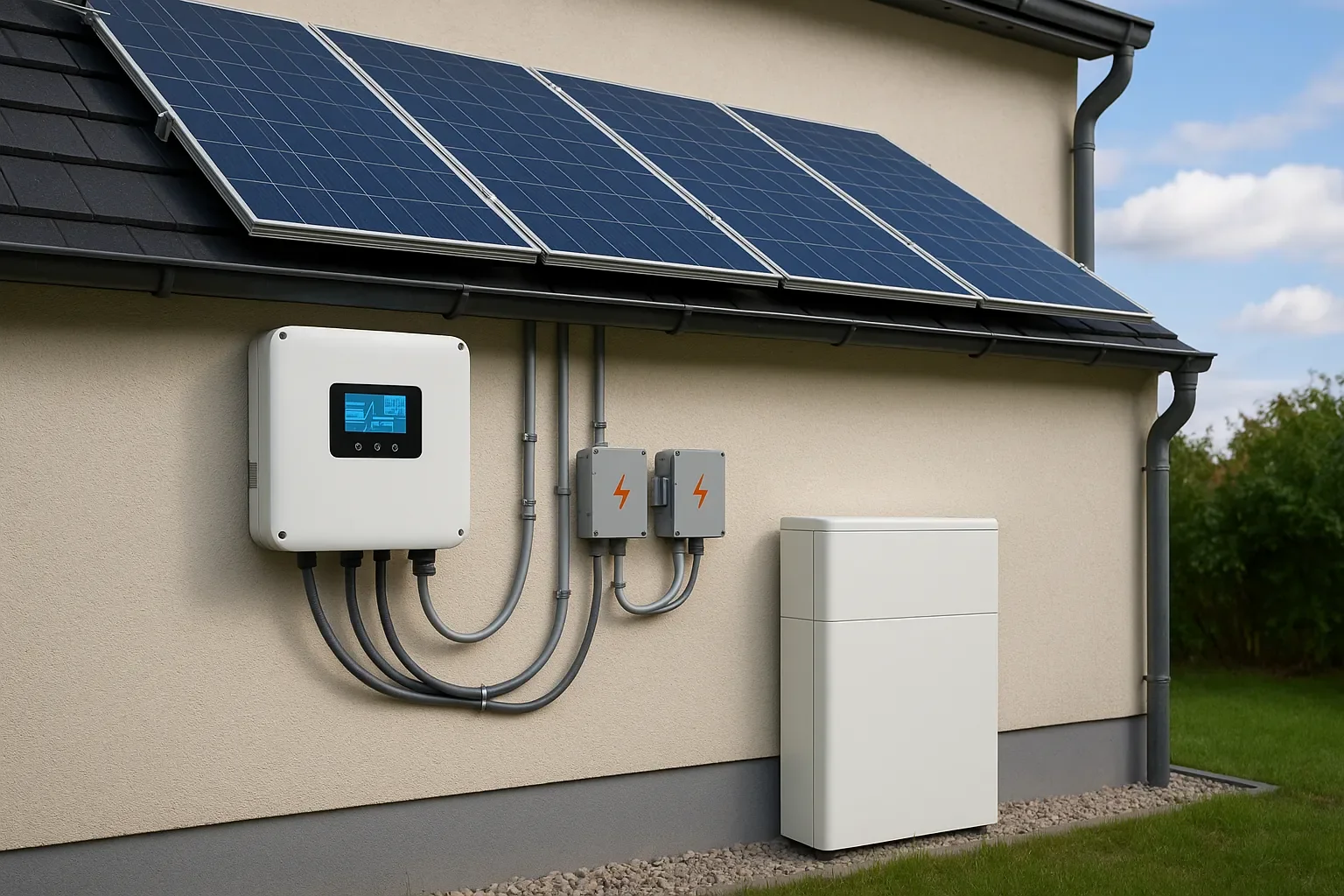 Future-ready design: Modular architecture allows easy expansion as your energy needs grow
The modular design provides unmatched flexibility for future changes. Adding an EV? Expand battery capacity to cover overnight charging. Installing a pool? Add modules to offset the pump load.
Vehicle-to-home integration is coming. Deye's high voltage architecture supports bi-directional charging once standards finalise and compatible vehicles arrive.
The system's open communication protocols mean integration with future smart home technology won't require replacement. Your investment stays relevant into the 2030s.
One caveat on expansion, because we'd rather you heard it from us. Adding modules years later works best when the new modules match the existing ones. Cell batches drift, manufacturers revise products, and a stack of mismatched generations is not ideal. If you know you'll want more capacity within twelve to eighteen months, buy it now. If it's five years away, plan for the possibility that you're adding a second stack rather than extending the first.
Deye Battery FAQ
Is Deye a good battery?
Yes, with the qualification that it's only as good as the installation. The cells are automotive-grade LiFePO4, the warranty is competitive at 10 years to 70% retention, and our own fleet data shows a lower failure rate than the industry average. It is our default recommendation for Sunshine Coast homes wanting 10kWh or more of storage.
How much does a Deye battery cost in Australia?
On the Sunshine Coast, installed and before rebates, roughly $8,500-9,500 for 5.12kWh, $13,000-14,500 for 10.24kWh, and $17,500-19,500 for 15.36kWh. Federal and state incentives can take $2,000-4,000 off depending on system size and timing.
How long does a Deye battery last?
The warranty runs 10 years to 70% capacity retention, and the cells are rated well past 6,000 cycles. Our earliest installations are still delivering close to original capacity. Realistically you should expect useful life well beyond the warranty period, with gradual capacity fade rather than a hard failure.
Is a Deye battery better than a Tesla Powerwall?
Better value, yes. Better product overall, it depends what you value. Deye gives you more storage per dollar, modular expansion, and stronger three-phase backup. Powerwall gives you brand recognition, a more polished app, an integrated inverter, and wider VPP program access. For most Queensland homes with a pool or ducted air conditioning, we recommend Deye.
Who makes Deye batteries?
Deye is a Chinese manufacturer that has been building solar inverters and energy storage systems since 2007, supplying distributors worldwide with a growing Australian presence including local warehousing and technical support.
Can I add a Deye battery to my existing solar system?
Usually yes. The cleanest result is replacing your existing inverter with a Deye hybrid so the battery is DC-coupled. If your current inverter is newer and you'd rather keep it, AC-coupling a battery alongside it is a valid option that costs a few percent in efficiency. Which makes sense depends on the age and size of your existing system.
Our Verdict: Why Deye Wins
After five years of installing every major battery brand across hundreds of Sunshine Coast homes, Deye consistently delivers the best overall package.
It's not the cheapest option upfront. It's not the most famous brand. It doesn't have the slickest marketing.
What it does have is the right combination of performance, reliability, flexibility, and value for Queensland conditions. The modular design means you can right-size your investment. The high voltage architecture handles our summers efficiently. The backup power actually works when you need it.
Most importantly, we sleep well knowing these systems won't generate angry callback calls. They just quietly do their job, storing your solar energy and reducing your bills without drama.
Making Your Decision
Choosing a battery system is a significant investment that will impact your energy costs for the next decade. While we believe Deye offers the best value for most Sunshine Coast homes, your specific situation might point to a different solution.
High energy users benefit from Deye's scalability up to 30.72kWh residential or 60kWh+ commercial systems. Backup power priorities favor the high output capability. Budget constraints might push toward a smaller initial system with expansion potential.
The key is matching the technology to your needs, not picking based on marketing hype or brand recognition alone. Look at real performance data, understand the warranty terms, and work with installers who'll be around to support the system long-term.
Solar batteries are finally mature enough to deliver genuine value for Queensland homeowners. Whether you're in Maroochydore, Mooloolaba, or Buderim, the technology now makes financial sense. Deye just happens to deliver that value better than most.
If you want a straight answer on what size you need and what it'll cost on your house, request a quote and we'll do the load analysis before we recommend anything. Full details of what we fit and what's included are on our battery installation page, and if you're chasing genuine independence rather than bill reduction, start with off-grid systems instead.
Considering battery storage for your Sunshine Coast home? Get an honest assessment of whether Deye or another solution best fits your needs. We install all major brands and will recommend what's genuinely best for your situation, not what pays the highest margin.