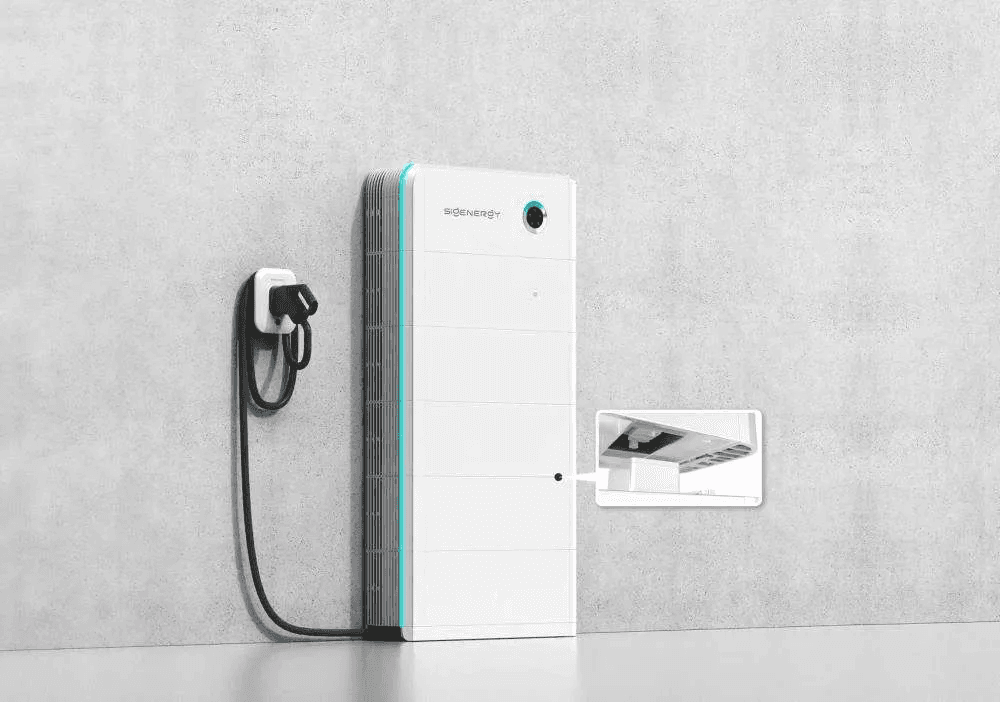

Sigenergy has become one of the batteries we're asked about most. The SigenStor looks good on a garage wall, stacks like building blocks, and is the only home system we install that puts a DC fast charger for your EV in the same cabinet as the battery. It also had a safety recall on some single-phase inverters in late 2025. A review that skips that isn't a review.
We install Sigenergy alongside Deye, Sungrow, BYD, Pylontech and Tesla, so we don't have a horse in this race. Here's our straight read.
The Short Version: Our Sigenergy Battery Verdict
Bottom line: the Sigenergy SigenStor is a genuinely well-engineered premium modular battery, and it's the best all-in-one option we install if you want EV charging built in. It uses LiFePO4 battery modules that stack one to six high on a single energy controller, covers single-phase and three-phase homes, and carries a 10-year warranty to 70% of usable energy. You pay more than you would for Deye or Sungrow, the warranty depends on keeping it online, and the 2025 recall on certain single-phase controllers is part of the record. For the right household it's excellent. For a value-first buyer, it's not where we'd start.
| Verdict at a glance | |
|---|---|
| Our rating | Premium all-in-one modular battery, best for EV owners and tidy installs |
| Chemistry | LiFePO4 (lithium iron phosphate) |
| Modules | BAT 5.0 (5.2 kWh usable) and BAT 8.0 (7.8 kWh usable), plus newer BAT 6.0 and BAT 10.0 |
| Stack size | 1 to 6 modules per energy controller |
| Inverter | Built into the stack: single-phase 3–12 kW, three-phase 5–30 kW |
| EV charging | Optional DC charging module, 12.5 kW or 25 kW |
| Warranty (AU) | 10 years on battery and controller, 70% usable energy or minimum throughput; 3 years on the EV DC module |
| Weak spots | Price, the 2025 single-phase controller recall, internet-dependent warranty |
A Sigenergy suits you if you:
- Own an EV, or will soon, and want fast DC charging from your solar and battery
- Want the neatest possible install: one cabinet, one app
- Are on three-phase and want one system that covers it properly
- Are building new or replacing an old inverter anyway
Look somewhere else if you're chasing the lowest cost per stored kWh, want to keep a healthy existing inverter, or have patchy internet where the battery would go. There's a full "who shouldn't buy one" section further down. If you'd rather we just look at your roof, switchboard and bills and tell you, get a free quote.
Last updated: 26 October 2026. This update added the late-2025 recall details, the Australian warranty conditions, the newer battery modules and SigenStor Neo, and refreshed pricing and rebate figures. Specifications are taken from Sigenergy's published Australian documents; check the current datasheet for the exact model on your quote.
How the SigenStor Actually Works
Most batteries need a separate inverter to do the clever work. The SigenStor doesn't. Sigenergy describes it as a "5-in-one" system: the solar inverter, the battery power conversion, the battery packs, the energy management system and the EV DC charger controls all live in one stack. In practice you get:
- The Sigen Energy Controller on top. This is the hybrid inverter, battery management and energy management in one unit. Your solar panels plug into it, and it connects to your switchboard.
- Battery modules stacked underneath, one to six of them.
- An optional EV DC charging module, so you can charge an EV directly from solar and battery on DC.
Each pack has its own built-in DC-DC optimiser, which Sigenergy says lets packs of different capacities and ages sit in the same stack. That's a real advantage if you add capacity years later; with most stacked systems, mixing old and new modules is something to avoid.
Sigenergy battery module sizes
The two long-standing LiFePO4 modules are the BAT 5.0 (5.38 kWh total, 5.2 kWh usable) and the BAT 8.0 (8.06 kWh total, 7.8 kWh usable). Sigenergy has since added BAT 6.0 and BAT 10.0 modules on larger cells in the same footprint, and they appear in its Australian warranty document. Clean Energy Council battery listings are per model, so check the exact module on your quote is on the current approved list; without it, there's no federal rebate.
With up to six modules per controller, the Sigenergy systems we quote typically sit between about 8 and 48 kWh.
The modules are IP66 rated and naturally cooled. Sigenergy's warranty sets the operating range at −20°C to 55°C and recommends 10–30°C for best battery life, so a shaded garage wall beats an outdoor wall in afternoon sun.
Sigenergy 3 phase inverter options
This is one of Sigenergy's genuine strengths. Energy controllers come in single-phase from 3 kW to 12 kW and three-phase from 5 kW to 30 kW.
Plenty of Sunshine Coast homes, especially newer builds with a pool and ducted air, are on three-phase supply, and some popular batteries handle it awkwardly, backing up only one phase or needing multiple units. A three-phase SigenStor covers it from one stack. If you're on three-phase and have been quoted a single-phase battery with "essential circuits" backup, ask which circuits and which phase before you sign.
Sigenergy also sells a separate Sigen Hybrid inverter and a Home Energy Gateway, so not every Sigenergy system is the all-in-one stack. Ask which configuration you're being quoted.
What about SigenStor Neo?
Sigenergy launched SigenStor Neo at Intersolar Europe in June 2026 as its next-generation all-in-one system. According to Sigenergy, it supports up to six stacked modules and adds a dedicated backup port plus a "smart port" for a generator, third-party inverter or heat pump.
We can't yet tell you how it performs on Sunshine Coast roofs or when each model will be approved here. Our rule for any new battery: don't buy until the exact model is on the Clean Energy Council's approved list and the Australian datasheet and warranty are published.
The 2025 Recall: What Happened and What It Means Now
On 19 November 2025, Sigenergy Australia and the ACCC published a voluntary recall (PRA 2025/20703) of SigenStor EC 8.0, 10.0 and 12.0 kW single-phase energy controllers fitted with quick-connect AC plugs, sold between 4 March and 18 November 2025.
According to the recall notice:
- The problem: the AC plugs could overheat and become damaged, posing a fire risk. Incidents occurred; no property damage, injuries or deaths were reported on the notice.
- The interim fix: a firmware update that lets Sigenergy monitor each system and temporarily reduce AC output if it's running at sustained full load.
- The remedy: a free replacement controller with an updated AC plug, arranged through the retailer or a Sigenergy Australia service partner.
- The sweetener: an additional two years of warranty on the affected product for affected customers.
Our read on it. A recall alone isn't a reason to write off a brand; the measure of a company is how it handles the fix. But it does mean three practical things:
- If you own a single-phase 8, 10 or 12 kW SigenStor bought in 2025, check the mySigen app for a recall notice, keep the system online for the firmware fix, and confirm whether your controller has been replaced.
- If you're buying now, get written confirmation that the controller supplied has the updated AC plug.
- If you're buying a house with one, check the serial number and recall status before settlement.
The recall was about the AC plug connection on specific single-phase controllers, not the battery modules or the three-phase range.
Sigenergy Warranty: Read the Conditions, Not Just the Number
Sigenergy's Australian warranty is competitive on paper: 10 years on the battery and the energy controller, with the batteries guaranteed to retain at least 70% of usable energy at 10 years, or a minimum energy throughput, whichever comes first. The EV DC charging module is covered for 3 years.
The conditions are where it gets interesting:
- It has to stay online. The system must remain connected to the internet for firmware updates. After 90 days offline it enters a "Safe Operation Mode", and after more than a year disconnected the warranty drops to 5 years from activation. Fix flaky garage Wi-Fi before the install.
- Labour is covered. Valid claims cover parts, on-site labour and basic travel, which is better than many battery warranties that cover the part only.
- Claims have a time limit. Sigenergy asks for claims within 30 days of the failure date, normally lodged through the mySigen app.
- Rust from harsh environments is excluded. Enclosure rust caused by harsh environmental conditions isn't covered, so on a beachfront install it under cover, out of salt spray.
- Transfer depends on location. The warranty transfers to a new owner only if the equipment stays at its original address.
None of this is sinister, but it matters in year seven. Ask for the current warranty document for the exact model on your quote and keep a copy.
Sigenergy vs Deye vs Tesla vs Sungrow vs BYD
The batteries that come up in nearly every quote conversation. Check current datasheets for the exact model you're quoted.
| Sigenergy SigenStor | Deye (HV modular) | Tesla Powerwall | Sungrow SBR | BYD Battery-Box | |
|---|---|---|---|---|---|
| Capacity | 1–6 modules per controller; our installs typically ~8–48 kWh | 5.12 kWh modules, up to 30.72 kWh | 13.5 kWh per unit, fixed | 9.6–25.6 kWh, modular | ~4 kWh modules, stackable |
| Chemistry | LiFePO4 | LiFePO4 | LFP | LFP | LFP |
| Inverter | Built into the stack | Matched Deye hybrid | Built in, 11 kW continuous (AU) | Best with a Sungrow hybrid | Third-party, wide compatibility |
| Three-phase | Yes, 5–30 kW controllers | Yes, three-phase hybrids | Depends on configuration | Depends on paired inverter | Depends on paired inverter |
| EV charging | Optional built-in DC module | No | No | No | No |
| Our positioning | Premium all-in-one, best for EV owners and tidy installs | Our default: best capacity and backup per dollar | Brand and simplicity, costs more per kWh | Excellent value with mature Australian support | Proven cells, flexible on inverter choice |
Where Sigenergy wins: integration. One cabinet, one app, one warranty contact, three-phase without fuss, mixable modules, and the only built-in DC EV charging we install. Where it loses: price per kWh against Deye and Sungrow, a shorter Australian track record that includes the 2025 recall, and an online-only warranty condition that doesn't suit every rural block.
For a detailed head-to-head with our default recommendation, see Deye vs Sigenergy, and for the full breakdown of our most-installed battery, read our Deye battery review.
Sigenergy Battery Price in Australia
We don't publish a Sigenergy-specific price, because controller size, modules and EV charging swing it a long way. Here's the band all the batteries we install fall into.
Installed battery prices on the Sunshine Coast, as at August 2026, before the rebate:
| Battery size | Installed, before rebate |
|---|---|
| 5 kWh | $8,500–$9,500 |
| 10 kWh | $13,000–$14,500 |
| 15 kWh | $17,500–$19,500 |
Sigenergy sits at the premium end of what we install, so expect a Sigenergy quote toward the upper end of each band for a comparable size, with the EV DC charging module as an extra. Switchboard upgrades and cable runs are the main variables on any battery job.
How much is the rebate on a SigenStor?
The federal Cheaper Home Batteries Program applies to approved Sigenergy modules the same way it applies to any eligible battery. Since 1 May 2026, it's worth roughly $252 per usable kWh for the first 14 kWh, then 60% of that rate from 14 to 28 kWh, and 15% from 28 to 50 kWh. It steps down every six months.
As illustrative arithmetic only: two BAT 8.0 modules give 15.6 kWh usable. The first 14 kWh at about $252 is roughly $3,528, and the remaining 1.6 kWh at 60% of the rate adds about $242, for a total in the region of $3,770. The exact figure depends on the rate on your install date and is confirmed in writing on the quote. The full rules are on our Queensland solar rebate guide.
Who Should NOT Buy a Sigenergy Battery
- You want the most storage per dollar. Deye or Sungrow will usually win on cost per stored kWh. Sigenergy's premium buys integration, not extra capacity.
- You have a healthy inverter you'd rather keep. If it's under about eight years old and working well, an AC-coupled battery alongside it is often the cheaper retrofit.
- Your internet is unreliable where the battery goes. With the warranty tied to staying online, a shed at the end of a long block with weak signal needs sorting first.
- You want a long local track record. If the 2025 recall makes you uneasy, that's a reasonable position, and there are good alternatives.
- You're on a beachfront with no sheltered spot. With enclosure rust from harsh environments excluded from the warranty, the battery needs a covered location out of salt spray.
- You're tied to a particular VPP. Each Virtual Power Plant keeps its own approved-device list. Check it for the exact Sigenergy model before you sign.
Our Verdict
Sigenergy makes one of the most thoughtfully engineered home batteries on the market. The all-in-one design, three-phase range, mixable modules and built-in DC EV charging are real advantages. The recall was a genuine stumble and the warranty conditions need reading, but neither is a deal-breaker for the right buyer.
For most Sunshine Coast homes whose priority is bill savings per dollar, we still lead with Deye. For EV owners, three-phase homes wanting one tidy system, and anyone who values integration enough to pay for it, Sigenergy is the one we'd put in front of you.
For a straight comparison on your own house, our battery installation team will size it from your evening usage and quote Sigenergy alongside an alternative.
Frequently asked questions
Are Sigenergy batteries any good?
Yes, for the right household. The SigenStor stacks one to six LiFePO4 modules on one energy controller, covers single and three-phase homes, offers built-in DC EV charging and carries a 10-year warranty to 70% usable energy. The trade-offs are a premium price, a 2025 recall on certain single-phase controllers, and a warranty that requires the system to stay online.
What is the life expectancy of a Sigenergy battery?
Sigenergy's Australian warranty covers the battery for 10 years, guaranteeing at least 70% of usable energy at that point or a minimum energy throughput, whichever comes first. Modern LiFePO4 batteries generally give 10–15 years of service, with gradual capacity fade rather than sudden failure. Installing it somewhere shaded and cool helps it reach the upper end.
Are Sigenergy batteries better than Tesla?
They suit different buyers. Sigenergy is modular, offers three-phase controllers up to 30 kW and built-in DC EV charging. The Tesla Powerwall is a fixed 13.5 kWh unit with an integrated inverter, 11 kW continuous output in Australia, a polished app and the strongest brand recognition, but it costs more per kWh. For EV owners and three-phase homes we usually prefer Sigenergy.
Which is better, Sungrow or Sigenergy?
Sungrow is the value pick, with modular SBR batteries from 9.6 to 25.6 kWh, good pricing and a mature Australian support network, especially when paired with a Sungrow hybrid inverter. Sigenergy is the premium pick, with an all-in-one stack, built-in EV charging and three-phase controllers up to 30 kW. If the budget is the priority, Sungrow; if integration and EV charging matter, Sigenergy.
How much does a SigenStor cost?
It depends on the controller, modules and EV charging. As at August 2026, batteries we install on the Sunshine Coast range from about $8,500–$9,500 for 5 kWh to $17,500–$19,500 for 15 kWh, installed before rebate, with Sigenergy toward the upper end. The federal battery rebate, around $252 per usable kWh for the first 14 kWh since 1 May 2026, comes off that.