
Victron gear turns up everywhere: caravans, boats, mining camps, sheds, and a lot of off-grid homes. That's its strength and, oddly, part of its problem. Because you can buy the parts online and bolt them together in endless combinations, we see some excellent Victron systems and some genuinely scary ones. The badge on the box is the same on both.
We install Victron and Selectronic for off-grid work across the Noosa hinterland and the Gympie region. Here's our installer's read on Victron for a house.
Is Victron good for an off-grid home?
Yes. Victron is a proven off-grid platform built around the MultiPlus-II and Quattro-II inverter-chargers, SmartSolar MPPT charge controllers and a GX device such as the Cerbo GX, which links the system to Victron's free VRM remote monitoring. The MultiPlus-II runs from 3,000 VA to 15,000 VA per unit, scales to parallel and three-phase systems, and Victron offers a 5-year standard warranty. It suits off-grid homes, farms and fringe-of-grid properties where flexibility, generator control and good monitoring matter.
The trade-off is that a Victron system is a set of components, not one box. The design and the install quality decide how well it works, more than with most brands.
What's in a Victron off-grid system?
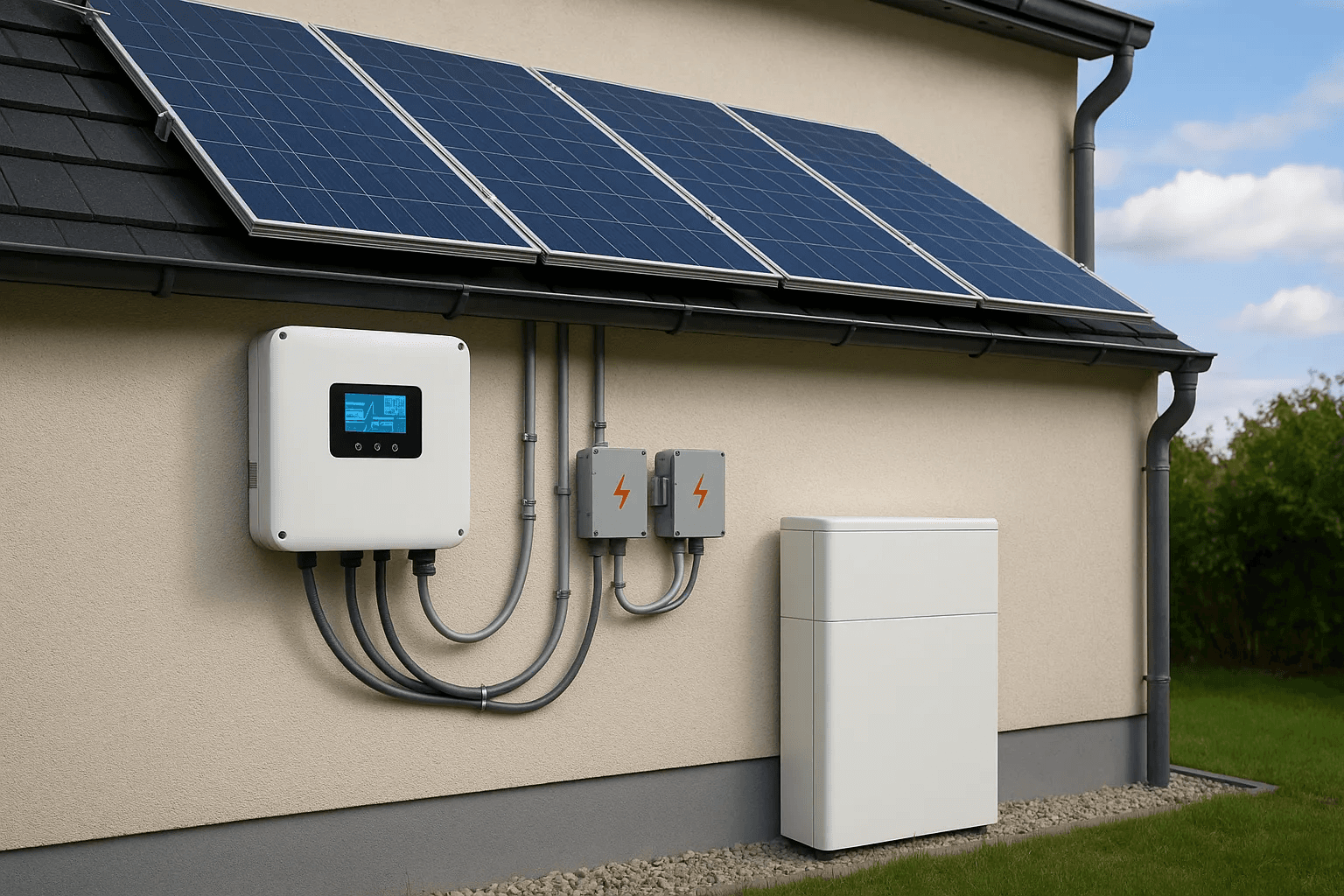
A typical Victron off-grid house is built from four kinds of part:
| Part | What it does | Victron product |
|---|---|---|
| Inverter-charger | Makes the 230V supply, carries the loads, charges the battery from a generator | MultiPlus-II or Quattro-II |
| Solar charge controller | Takes DC from the panels and charges the battery | SmartSolar MPPT |
| System controller | Ties everything together, runs generator auto start, connects to monitoring | Cerbo GX (or another GX device) |
| Battery | Stores the energy | A compatible lithium battery, often with a managed BMS link |
Add the switchboard, DC protection, a generator and the panels, and that's the system. Each part is chosen and sized separately, which is the whole appeal of Victron and the reason design matters so much.
Victron MultiPlus-II: the workhorse
The MultiPlus-II is the inverter-charger at the centre of most Victron homes. Victron describes it as a multifunctional inverter/charger with two AC outputs, suitable for land-based off-grid systems, with parallel and three-phase configurations for bigger sites (Victron MultiPlus-II).
The model names tell you what you're getting. 48/5000/70-50 means a 48V battery, 5,000 VA, a 70 A charger and a 50 A transfer switch.
Victron's published figures for the 48V, 230V models, as at November 2026:
| Model | Continuous power at 25°C | Peak power | Max charge current |
|---|---|---|---|
| 48/3000/35-32 | 2,400 W | 5,500 W | 35 A |
| 48/4k5/55-32 | 4,000 W | 7,000 W | 55 A |
| 48/5000/70-50 | 4,000 W | 9,000 W | 70 A |
| 48/6k5/100-50 | 6,000 W | 11,000 W | 100 A |
| 48/8000/110-100 | 6,400 W | 15,000 W | 110 A |
| 48/10000/140-100 | 8,000 W | 18,000 W | 140 A |
| 48/15000/200-100 | 12,000 W | 27,000 W | 200 A |
Two things to notice. First, the VA figure in the name isn't the continuous wattage. A 5000 is a 4,000 W continuous inverter at 25°C. Second, the peak figures are generous. That surge headroom is what starts a bore pump or a fridge compressor without dropping the house. Our off-grid inverter guide explains how to size for continuous load and surge.
PowerControl and PowerAssist
These are the features that make the MultiPlus-II work well with a generator. Victron's explanation, simplified: when a limited source like a generator is connected, the MultiPlus-II first reduces battery charging so the generator isn't overloaded. If the loads still exceed what the generator can supply, it tops up the generator's output with power from the battery.
In practice that means you can run a sensibly sized generator rather than one big enough to carry every load plus full-speed charging at once.
Switchover in milliseconds
When a generator or grid supply drops out, Victron states the inverter takes over the loads in less than 20 milliseconds, fast enough that computers keep running. On an off-grid home, that matters most at the moment the generator shuts down.
Victron Quattro-II: when you need two AC inputs
The Quattro-II is the MultiPlus-II's sibling. Victron says it can accept two AC inputs, for example two generators or a generator and another supply, and automatically connects to the active source. Up to six Quattro-II units can run in parallel, with three-phase or split-phase operation possible (Victron Quattro-II).
For most single off-grid homes, one AC input (the generator) is all you need, so the MultiPlus-II is the usual pick. The Quattro-II earns its place on properties with two generators, or a fringe-of-grid site that wants both a grid connection and a generator wired in.
SmartSolar MPPT charge controllers
On most off-grid builds, the panels connect to the battery through Victron SmartSolar MPPT charge controllers. MPPT is the electronics that keeps the panels working at their best point as the light changes through the day.
Victron states its SmartSolar controllers are 98% efficient and can be monitored and configured with the VictronConnect app, or linked to a GX device for VRM (Victron solar charge controllers). The naming is simple: in a 250/100, the first number is the maximum PV open-circuit voltage and the second is the maximum charge current.
Because the controllers are separate, you can split an array across several MPPTs, for example one per roof face or one for a ground-mounted array down the paddock. It also means solar keeps charging the battery even if the inverter-charger is switched off for service.
Victron also supports AC coupling, where a grid-type solar inverter connects to the MultiPlus-II's output. It works, within limits. Victron's Factor 1.0 rule says the inverter-charger's VA rating must be at least the AC-coupled solar in watts (Victron: AC-coupling and the Factor 1.0 rule).
Cerbo GX and VRM: the system's brain and window
The Cerbo GX is Victron's communication centre. It talks to the inverter-charger, the MPPTs and a compatible battery, runs the system logic, and connects to the internet. Victron lists automatic generator start and stop among its features, including quiet periods and warm-up and cool-down times (Victron Cerbo GX).
Through the Cerbo GX, the system reports to VRM, Victron's free remote monitoring portal and app. You can see battery state of charge, solar production, loads and generator runs from your phone. For us, VRM is one of Victron's best features. We can look at a system an hour away before deciding whether to drive out, which saves owners time and money.
Victron and generators
We recommend a generator on almost every off-grid home, and Victron handles them well. The Cerbo GX can start the generator based on conditions your installer sets, such as the battery dropping to a set point, and stop it when the job's done. PowerAssist and PowerControl then manage how hard the generator works.
Getting the settings right takes some care: start and stop thresholds, charge current limits, quiet hours, minimum run times. Set badly, a generator either runs far more than it needs to or not when it should. Our guide to choosing an off-grid generator covers sizing and auto start.
Victron warranty
Victron offers a 5-year standard warranty on its products. Victron's own guidance is to contact your original dealer for support, repairs or warranty requests (Victron warranty and repairs).
That second part matters. If you bought a Victron kit online from a seller who isn't around in five years, your warranty path gets harder. Buy through an installer who'll still answer the phone. Every Keystones install also carries our own 10-year workmanship warranty.
The honest downsides
Victron is excellent kit, but it isn't the right answer for everyone.
- More parts to design. Inverter-charger, MPPTs, GX device, battery communications and DC protection all have to be chosen and matched. One undersized part limits the lot.
- Configuration takes know-how. There are a lot of settings, and they interact. A wrong battery charge setting can shorten battery life; a wrong generator setting can leave you in the dark.
- Install quality varies widely. Because the parts are easy to buy, plenty of Victron systems in the wild were built without proper design or protection. When we're called to a fault on someone else's Victron install, the problem is far more often the wiring, the protection or the settings than the equipment.
- Spread across several boxes. Some owners prefer Selectronic's approach of one central inverter-charger managing everything.
None of these are reasons to avoid Victron. They're reasons to have it designed and installed by someone who does it regularly.
Victron vs Selectronic
They're the two off-grid platforms we install most, and both are good. Selectronic is Australian designed and manufactured, built around one central inverter-charger with integrated generator control. Victron is modular, with a huge ecosystem and excellent monitoring. We've laid out the side-by-side in our Selectronic SP PRO review.
Our view: for a full-time off-grid home, pick the platform that suits your loads, battery and site, then make sure the installer knows it inside out. The design matters more than the badge.
Who Victron suits (and who it doesn't)
Victron suits you if:
- You want a flexible system that can grow, from a cabin to a full home to a farm
- You want strong remote monitoring through VRM
- You have heavy motor loads and want generous surge headroom
- Your property needs two AC inputs or three-phase, where the Quattro-II and parallel setups help
Look elsewhere if:
- You want one box with as few separate components as possible
- You're on a suburban grid-connected home that just wants a battery. A hybrid inverter built for that job is usually simpler.
If you're planning an off-grid home, we'll design the whole system around your loads and your worst week of weather, then recommend the platform that fits. Start with our off-grid solar systems page, and see our off-grid battery sizing guide for the storage side.
Frequently asked questions
What is a Victron MultiPlus-II?
It's Victron's main inverter-charger. It turns battery power into a 230V supply, charges the battery from a generator or grid, and switches between sources in under 20 milliseconds. Models run from 3,000 VA to 15,000 VA per unit and can be combined in parallel or three-phase.
What's the difference between a Victron MultiPlus-II and a Quattro-II?
The Quattro-II accepts two AC inputs, such as two generators, and automatically connects to whichever is active. The MultiPlus-II has one AC input. Most single off-grid homes only need one input for the generator.
Is Victron VRM free?
Yes. Victron describes the VRM portal and app as free. You need a GX device, such as the Cerbo GX, and an internet connection at the property.
Can a Victron system start a generator automatically?
Yes. A GX device such as the Cerbo GX can start and stop a generator based on conditions your installer sets, such as battery state of charge, with quiet periods and warm-up and cool-down times.
What warranty does Victron have?
Victron offers a 5-year standard warranty. Warranty and repair requests go through your original dealer, so buy from an installer who'll still be around.
Is Victron better than Selectronic for off-grid?
Neither is better across the board. Victron is modular, with excellent monitoring and a broad range. Selectronic is Australian-made, with one central inverter-charger and integrated generator control. The installer's experience with the platform matters more than the brand.