
Most people pricing an off-grid system spend their time on panels and batteries. Fair enough, they're the big numbers on the quote. But the inverter is the part that decides whether the house actually works. It's the thing that has to start the bore pump at 6am, keep the fridge running while the kettle boils, and call the generator in when the battery runs low after four grey days.
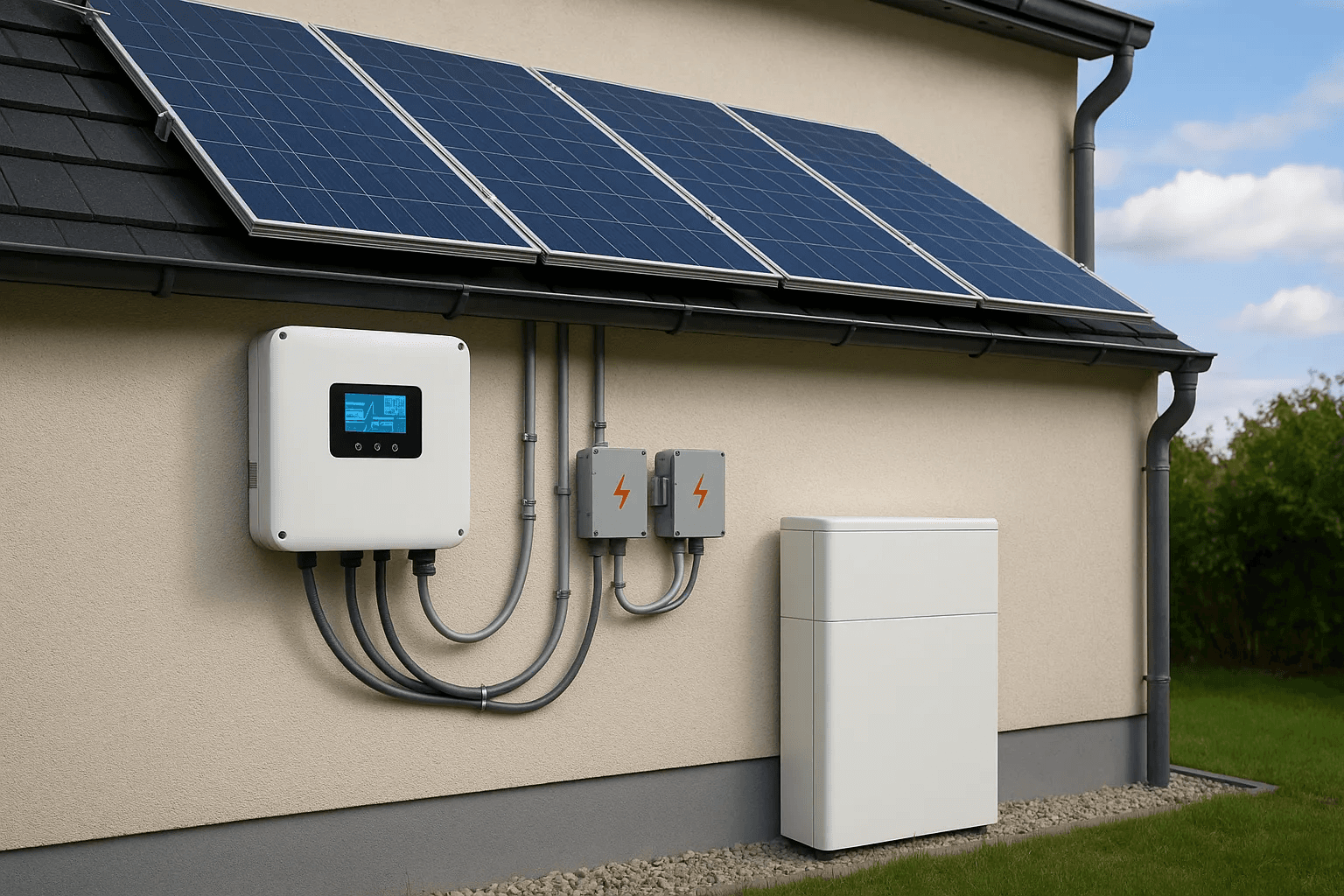
An off-grid inverter is an inverter-charger: it turns battery power into the 230V supply for the whole property, charges the battery from a generator, and manages the solar, battery and generator as one system. To size one, you need two numbers: the continuous load (the most power you'll draw at once for a sustained period) and the surge (the short spike when motors like pumps and compressors start). Then you match the battery voltage, the generator, and whether you need single or three-phase. A grid "hybrid" inverter with a backup output is not the same thing, even though the brochures can make it sound close.
We design and install off-grid systems across the Noosa hinterland and the Gympie region, mostly on Selectronic and Victron. Here's how we choose and size the inverter.
What does an off-grid inverter do?
On a grid-connected house, the inverter has an easy job. The grid sets the voltage and frequency, and the inverter just pushes solar power into it. When the grid drops out, a standard solar inverter shuts down.
Off-grid, there is no grid. The inverter is the grid. It has to:
- Form the AC supply. Make a stable 230V, 50 Hz supply from the battery, all day and all night.
- Carry every load in the house, including the start-up surge of motors.
- Charge the battery from a generator (and on some systems, from AC-coupled solar).
- Manage the system. Decide when to start and stop the generator, protect the battery from running flat, and log what's happening.
That's why off-grid inverters are usually called inverter-chargers or multi-mode inverters. One box does the inverting, the charging and the thinking.
Can a hybrid inverter run off-grid?
This is the question we get most, usually from someone who's been quoted a grid hybrid for a rural block.
Some can, but a grid hybrid with a backup output is not automatically a true off-grid inverter. A grid hybrid is designed to sit on the grid every day and run a backup circuit through the occasional blackout. A dedicated off-grid inverter-charger is designed to run the whole property every day with no grid behind it.
The differences that matter in practice:
| Grid hybrid with backup | Off-grid inverter-charger | |
|---|---|---|
| Designed for | Daily grid connection, occasional outage | No grid, every day |
| Loads covered | Often a backup circuit or essential loads | The whole property |
| Surge capacity | Varies, check the spec | A core design priority |
| Generator input and control | Often limited or not supported | Built in, usually with auto start |
| Battery charging from AC | From the grid | From the generator |
Some hybrid inverters do list an off-grid mode, and on a small site that can work. Before you rely on one, check the manufacturer's spec sheet for three things: a generator input, a surge rating that covers your biggest motor, and confirmation that permanent off-grid use is supported. If any of those are missing, it's a backup inverter, not an off-grid one.
How to size an off-grid inverter
Battery capacity (kWh) is the size of the tank. The inverter rating (kW) is how fast you can draw from it. An off-grid system needs both right, and they're sized separately.
Step 1: Continuous load
List everything that could realistically run at the same time on a bad evening. Not everything in the house, just the worst plausible overlap.
Example numbers only, to show the method:
| Load (illustrative) | Running power |
|---|---|
| Fridge and freezer | 300 W |
| Lights, TV, router, chargers | 400 W |
| Kettle | 2,000 W |
| Pressure pump | 800 W |
| Washing machine | 500 W |
| Total continuous | 4,000 W |
Then add headroom. Inverters are rated at a set temperature, and a battery room in a Queensland shed in January is not that temperature. Victron, for example, publishes its MultiPlus-II continuous ratings at 25°C (Victron MultiPlus-II specifications). So this example household would be looking at an inverter comfortably above 4 kW continuous, not one rated at exactly 4 kW.
Step 2: Surge
Motors pull a spike of power for a moment when they start, well above their running draw. Bore pumps, pressure pumps, fridge compressors, air conditioners and power tools all do it. With no grid to lean on, the inverter has to supply that spike on its own.
The starting current is on the motor's spec plate or data sheet, or your pump supplier can give it to you. Don't guess it. Then check the inverter's peak or surge rating covers your biggest motor starting while the rest of the house is running.
To give you a sense of how manufacturers state it, Victron's MultiPlus-II 48/5000 is rated at 4,000 W continuous and 9,000 W peak at 25°C. Read both numbers on any inverter you're quoted. A big continuous rating with a weak surge rating is how you end up with lights that flicker and a system that trips every time the bore pump kicks in.
If you're running a submersible bore pump, our guide to the solar bore pump covers the options, including pumps that run straight off their own panels and never touch the inverter.
Step 3: Battery voltage
Off-grid inverters run on 12V, 24V, 48V or higher battery systems. For a house, 48V is the usual starting point, and the reason is simple arithmetic. Power = volts × amps, so the same load at a lower voltage needs more current, and more current needs heavier cable and bigger fuses.
- 5,000 W at 48V ≈ 104 A
- 5,000 W at 24V ≈ 208 A
- 5,000 W at 12V ≈ 417 A
12V is for caravans, boats and small sheds. 24V suits small cabins. Whole homes are normally 48V, and Selectronic also makes 120V models for larger systems. Whatever you pick, the battery has to be on the inverter maker's compatibility list, and on a managed lithium battery the inverter and battery need to talk to each other properly. Our off-grid battery sizing guide covers the kWh side.
Step 4: Charger and generator input
The charger rating decides how quickly a generator can refill the battery. Again using Victron's published figures as an example, the MultiPlus-II 48/5000 charges at up to 70 A. At a nominal 48V, that's roughly 70 × 48 ≈ 3.4 kW going into the battery.
That number matters when you choose the generator. It needs to cover the charging plus whatever the house is drawing while it runs. Too small and it overloads. Much too big and it spends its life lightly loaded, so check the generator maker's guidance on minimum load. Good off-grid inverters can also limit the charge rate or share the load to protect a small generator. Victron calls this PowerControl and PowerAssist. Our guide to choosing an off-grid generator goes through sizing and auto start in more detail.
AC coupled vs DC coupled off-grid solar
There are two ways to get solar into an off-grid battery.
DC coupling runs the panels through a solar charge controller (an MPPT, the electronics that squeeze the most out of the panels) straight into the battery. It's simple, it keeps working if the inverter is off, and it's the backbone of most off-grid designs.
AC coupling connects a normal grid-type solar inverter to the output side of the off-grid inverter. The off-grid inverter makes the "grid" the solar inverter needs, and the solar power feeds the loads and charges the battery back through the inverter-charger.
The catch with AC coupling off-grid is what happens when the battery is full. There's nowhere for the solar to go. The off-grid inverter handles that by shifting its output frequency, which tells the solar inverter to throttle back. Victron explains this frequency-shift method and sets a hard limit it calls the Factor 1.0 rule: the inverter-charger's VA rating must be at least the installed AC-coupled solar in watts, for example a 3,000 VA unit for up to 3,000 Wp of AC-coupled PV (Victron: AC-coupling and the Factor 1.0 rule). It also sets a minimum battery size for the amount of AC-coupled solar.
| DC coupled | AC coupled | |
|---|---|---|
| How solar connects | Charge controller into the battery | Grid-type solar inverter on the AC side |
| Good for | New off-grid builds | Expanding a system, or reusing an existing solar inverter |
| Limits | Charge controller ratings | Must stay within the off-grid inverter's limits and battery minimums |
Most of our new off-grid builds are DC coupled, often with some AC coupling where it makes sense. Selectronic's SP PRO supports both, and so does Victron.
Single or three-phase off-grid?
Most off-grid homes are single phase. Three-phase comes in when a property has three-phase motors, like some irrigation pumps or workshop machinery, or when the total load is too big for one unit.
Both platforms we install scale this way. Selectronic's Powerchain combines multiple SP PRO units up to 240 kW across three phases, and Victron's MultiPlus-II supports parallel and three-phase configurations. If you only have one three-phase motor, it's worth asking whether a single-phase alternative or a variable-speed drive is cheaper than building the whole system as three-phase.
Monitoring: you'll use it more than you think
On a grid-connected house, monitoring is a nice-to-have. Off-grid, it's how you know what's coming. You want to see the battery state of charge, today's solar, what's drawing power and when the generator last ran, ideally from your phone.
- Selectronic uses Select.live for remote monitoring, plus SP LINK on a Windows PC for configuration.
- Victron uses a GX device such as the Cerbo GX, which connects to the free VRM portal and app (Victron Cerbo GX).
Remote monitoring also lets your installer look at a fault before driving out. On a rural property an hour away, that's a big deal.
What's the best off-grid inverter in Australia?
The two we install for off-grid homes are Selectronic and Victron. Both are proven, both handle generators properly, and both scale from a cabin to a farm.
- Selectronic SP PRO: Australian designed and manufactured, one central inverter-charger with integrated generator control. Our Selectronic SP PRO review covers the range, warranty and the Selectronic vs Victron comparison.
- Victron: a modular ecosystem of inverter-chargers, charge controllers and monitoring. Our Victron off-grid system review covers the MultiPlus-II, Quattro and VRM.
Honestly, the badge matters less than the design and the installer. A well-designed Victron system and a well-designed Selectronic system will both run a house for years. A badly sized inverter of either brand will trip on the first cold morning the pump and the kettle start together.
Common off-grid inverter mistakes
- Sizing on continuous load only. Surge is what trips systems.
- Using a grid hybrid's backup output as an off-grid supply without checking generator input and surge.
- Mismatching the generator to the charger rating and the loads.
- Too much AC-coupled solar for the inverter and battery to absorb.
- Buying the inverter before the design. Work out the loads, the battery and the generator first, then pick the inverter that suits them.
If you're planning a build, we'll size the inverter, battery, array and generator together, around your loads and your worst week of weather. See our off-grid solar systems on the Sunshine Coast for how we work.
Frequently asked questions
What size inverter do I need for an off-grid house?
Add up the loads that could run at the same time on a bad evening, add headroom for heat, then check the surge rating covers your biggest motor starting while everything else is on. There's no standard size. Your figure comes from your own loads.
What is the difference between an off-grid inverter and a hybrid inverter?
A hybrid inverter is built to run on the grid every day and back up some circuits in a blackout. An off-grid inverter-charger is built to run the whole property with no grid, handle motor surges, and charge the battery from a generator it can start and stop itself.
Can I use a hybrid inverter off-grid?
Sometimes. Check the manufacturer confirms permanent off-grid operation, that it has a generator input, and that its surge rating covers your loads. If it can't do all three, use a dedicated off-grid inverter-charger.
Is 24V or 48V better for an off-grid system?
For a house, 48V. The same power at 48V needs half the current of 24V, so cables and fuses are smaller and losses are lower. 24V suits small cabins, and 12V is for caravans and boats.
What is AC coupling in an off-grid system?
AC coupling connects a grid-type solar inverter to the output of the off-grid inverter-charger. When the battery is full, the off-grid inverter shifts its frequency to make the solar inverter throttle back. It's useful for expanding a system, but it has to stay within the inverter's limits, such as Victron's Factor 1.0 rule.
Do off-grid inverters need a generator?
Not to work, but we recommend a generator on almost every off-grid home. A good off-grid inverter starts it automatically when the battery drops to a set point, recharges the battery and shuts it down again.