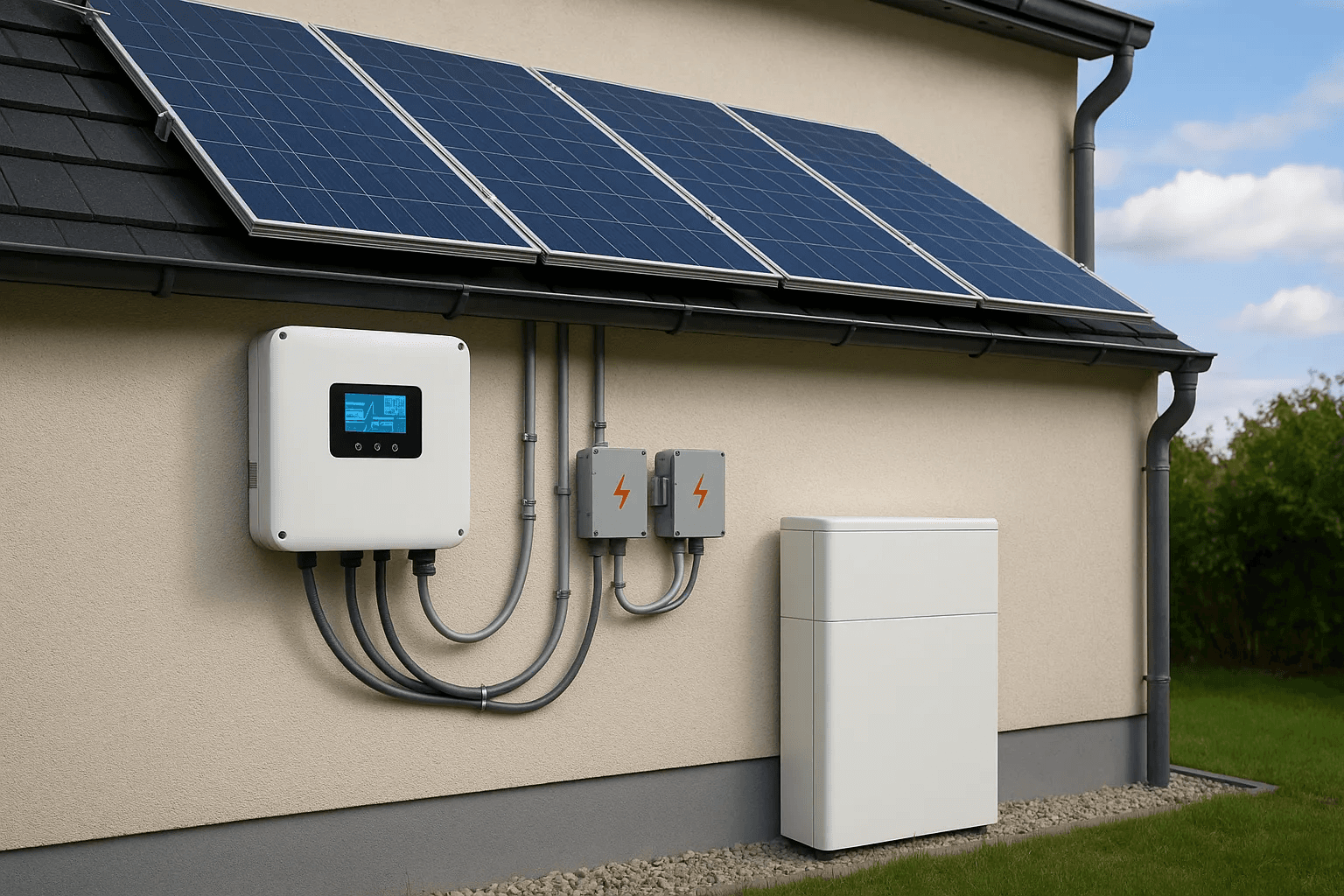

GoodWe turns up on a lot of the battery quotes people bring us, and it's one of the brands we install. The ESA all-in-one in particular has changed the conversation: it puts the hybrid inverter and the battery in one stack, with whole-home backup built in.
That's the good news. The warranty has a couple of clauses every Sunshine Coast buyer should read before signing, and there was a recall on some older GoodWe hybrids in 2025. Here's the full picture.
Is a GoodWe battery any good?
Yes. GoodWe's ESA all-in-one is one of the more complete home batteries available: LFP battery modules from 5 to 9 kWh that stack as high as 108 kWh, IP66, backup switching in under 4 milliseconds and a 63A bypass for whole-home backup, with a 10-year Australian warranty to 70% of usable energy. We install GoodWe on the Sunshine Coast. The catch is in the warranty: a coastal exclusion, short claim windows and hardware-only cover, which means where and how it's installed matters.
| Verdict at a glance | |
|---|---|
| Our rating | A capable, well-specified all-in-one at a mid-market price |
| Chemistry | LFP (LiFePO4) |
| ESA modules | 5.0, 5.9, 8.0 and 8.85 kWh usable; up to 12 modules |
| Inverter | Built into the stack: single-phase 3–10 kW, three-phase 5–30 kW |
| Backup | Under 4 ms switching, 63A bypass for whole-home backup |
| Warranty (AU) | 10 years, 70% usable energy or minimum throughput |
| Watch for | Coastal exclusion, two-week claim window, labour not guaranteed |
Last updated: 26 October 2026. Specifications come from GoodWe's Australian ESA datasheet and its ESA (3–10 kW) limited warranty for Australia and New Zealand. Check the current documents for the exact model on your quote.
The GoodWe battery range in Australia
GoodWe sells two main residential battery families here, and they suit different jobs.
ESA: the all-in-one
The ESA stacks a power module (the hybrid inverter) on top of battery modules in one cabinet. According to GoodWe's Australian ESA datasheet, the single-phase power modules run from 3 kW to 9.999 kW, and a three-phase ESA covers 5 to 30 kW.
The battery modules are where it gets flexible:
| Module | Rated energy | Usable energy |
|---|---|---|
| GW5.1-BAT-D | 5.12 kWh | 5.0 kWh |
| GW8.3-BAT-D | 8.32 kWh | 8.0 kWh |
| GW6.0-BAT-D | 6.0 kWh | 5.9 kWh |
| GW9.0-BAT-D | 9.0 kWh | 8.85 kWh |
Up to 12 modules per system (six in a single stacked column), for a total range GoodWe quotes as 5 to 108 kWh. Other datasheet points:
- IP66 on both the power module and battery modules.
- Under 4 ms switching to backup, and a 63A bypass so the system can carry the whole house rather than a few essential circuits.
- Fanless, with noise listed at 30 dB or less on the smaller power modules.
- Integrated battery heating and aerosol fire extinguishing on the main modules.
- GoodWe says you can mix capacities, and old and new modules, in one system.
There's also an AC-coupled ESA for adding storage to an existing solar system without replacing a healthy inverter. If you've been quoted Growatt's MINA, its all-in-one answer to the ESA, our Growatt battery review covers it.
Lynx Home F G2: a separate battery tower
The Lynx Home F G2 is the more traditional setup: a battery tower beside a separate GoodWe hybrid inverter. GoodWe's Lynx F G2 page lists 6.4 to 28.8 kWh usable per tower, built from 3.2 kWh LFP modules, with up to eight towers in parallel. It pairs with GoodWe's EH (single-phase) and ET (three-phase) hybrids. Note the enclosure is IP55, not IP66, which matters for siting.
GoodWe battery specs compared
| Model | Usable kWh per module | Stackable to | Chemistry | Warranty (AU) | Backup |
|---|---|---|---|---|---|
| ESA (single-phase) | 5.0 / 5.9 / 8.0 / 8.85 kWh | 12 modules, up to 108 kWh | LFP | 10 yrs, 70% or throughput | Built in, under 4 ms, 63A bypass |
| ESA (three-phase) | Same modules | Up to 108 kWh | LFP | Check the three-phase warranty | Built in, under 4 ms |
| Lynx Home F G2 | 3.2 kWh | 28.8 kWh per tower, 8 towers | LFP | 10 yrs | Via EH or ET hybrid |
GoodWe inverter review: what sits behind the battery
GoodWe makes both string and hybrid inverters and has been a common sight on Australian roofs for years. On the ESA single-phase power modules, the datasheet lists maximum efficiency of 97.5 to 97.6%, integrated arc-fault protection (AFCI), two to four MPPTs depending on size, and PV input up to double the inverter rating (20 kW of panels on the 9.999 kW model). The power module derates from 40°C, which we come back to below.
The 2025 GoodWe hybrid inverter recall
On 19 September 2025, GoodWe Australia published a voluntary recall (PRA 2025/20623) for EHB series hybrids (GW5K-EHB-AU-G11, GW8.6K-EHB-AU-G11 and GW9.99K-EHB-AU-G11) and the GE-branded GEH series it made, sold between 3 May 2021 and 4 September 2025.
According to the notice, if the bypass switch was set to bypass while the inverter was running in backup mode, it could export power to the grid, creating an electric shock risk for people working on switchboards or power lines. The fix is a firmware upgrade (version 050531), applied remotely to online units, with a technician visit for offline ones.
If you own one: don't use the bypass switch until you've confirmed the new firmware is installed, and contact GoodWe. The recall covers those inverter models, not the ESA or Lynx batteries.
GoodWe warranty: the clauses that matter on the coast
GoodWe's ESA warranty for Australia and New Zealand gives 10 years on the battery modules and power modules, and 2 years on the WiFi/4G kits and meters. The battery must retain 70% of usable energy within 10 years, or reach a minimum throughput first: 18.25 MWh for the 5.0 kWh module and 29.20 MWh for the 8.0 kWh module. GoodWe says that equates to one full cycle a day.
The conditions worth knowing:
- The coastal clause. Faults or damage from exposure to sea coasts, saltwater or other aggressive atmospheres are excluded unless GoodWe gave written approval before installation. Enclosure rust from harsh conditions is excluded too.
- Short claim windows. Faults must be reported within one month of appearing, and the claim made within two weeks of the failure date.
- Hardware, not labour. The warranty covers the cost of replacement hardware. A rebate towards on-site labour is at GoodWe's discretion.
- The clock can start early. The warranty starts at installation or six months after production, whichever is earlier.
- No direct sun. The battery must not be installed in direct sunlight.
- Storms excluded. Storm, flood and lightning damage are force majeure.
That July 2025 warranty lists the 5.0 and 8.0 kWh modules. If your quote uses the newer 5.9 or 8.85 kWh modules, ask for the current warranty covering them. The Australian importer is GoodWe Australia Pty Ltd in Rowville, Victoria.
GoodWe battery price on the Sunshine Coast
Installed battery prices on the Sunshine Coast, as at August 2026, before the rebate:
| Battery size | Installed, before rebate |
|---|---|
| 5 kWh | $8,500–$9,500 |
| 10 kWh | $13,000–$14,500 |
| 15 kWh | $17,500–$19,500 |
GoodWe generally sits in the middle of the market on price: more than a value modular stack, less than a premium all-in-one with built-in EV charging. Switchboard upgrades and cable runs move a job within each band more than the brand does.
How much is the rebate on a GoodWe ESA?
Since 1 May 2026 the federal Cheaper Home Batteries Program pays roughly $252 per usable kWh for the first 14 kWh, then 60% of that rate from 14 to 28 kWh. As illustrative arithmetic only: two 8.0 kWh modules give 16 kWh usable. The first 14 kWh earns about $3,528 and the remaining 2 kWh about $302, for roughly $3,830 off. The rate steps down every six months; see our Queensland solar rebate guide for the full rules.
GoodWe vs Sigenergy
Both now offer an all-in-one stack, so the gap has narrowed. Sigenergy's SigenStor offers an optional DC EV charging module in the stack and sits at the premium end of what we install. GoodWe's ESA has no built-in EV charger but offers the 63A bypass and a wide module range at a lower price. If EV charging from the battery cabinet matters, look at our Sigenergy battery review. If it doesn't, the ESA is the better-value all-in-one.
Sungrow or GoodWe?
We install both, and both are sound choices with Australian offices handling warranty. Sungrow's strength is its long-established local support network and SBR/SBH modular batteries on its SH hybrids; GoodWe's is the ESA's integration, IP66 rating and whole-home bypass. The deciding factors are usually backup needs and which warranty conditions suit your site. Our Sungrow battery review covers its side in detail.
The Sunshine Coast angle
- Salt air. This is the big one. Because of the coastal exclusion, any GoodWe install near the water should be under cover, out of salt spray, and documented, and if the site is genuinely exposed, ask the installer to get GoodWe's written approval first. Our guide to salt air and coastal solar corrosion explains why this matters for every brand.
- Heat. The ESA power module derates from 40°C ambient and the warranty bans direct sun. A shaded garage or carport wall beats a sunny west wall.
- Storms. The 63A bypass and under-4 ms switching make the ESA one of the better options for riding through a storm outage, if the switchboard is set up for whole-home backup.
- Grid connection. Energex approves the connection and sets export limits before installation. Your exact limit is confirmed at application.
Who GoodWe suits, and who should skip it
A GoodWe battery suits you if you:
- Want an all-in-one cabinet with whole-home backup, without paying for EV charging you won't use
- Want flexible sizing, from about 5 kWh to well past 20 kWh
- Have a sheltered, shaded install spot
Look somewhere else if you:
- Need the battery in an exposed spot near the beach with no shelter
- Want EV charging built into the battery cabinet
- Want a warranty that guarantees on-site labour is covered
Our verdict
GoodWe's ESA is a well-specified, well-priced all-in-one, and it's a brand we're happy to install. Read the warranty with your site in mind, particularly the coastal clause and the claim windows, and get it installed somewhere cool and sheltered. For most homes wanting the best capacity per dollar we still lead with Deye (see our Deye battery review), but GoodWe is a strong alternative. Our battery installation team on the Sunshine Coast will quote it alongside one so you can compare.
Frequently asked questions
How much is a GoodWe battery?
It depends on capacity, the power module and your switchboard. As at August 2026, the batteries we install on the Sunshine Coast range from about $8,500–$9,500 for 5 kWh to $17,500–$19,500 for 15 kWh, installed before the rebate, and GoodWe generally sits mid-market. The federal rebate, about $252 per usable kWh for the first 14 kWh since 1 May 2026, comes off that.
Is GoodWe battery good?
Yes. The ESA uses LFP modules, is rated IP66, switches to backup in under 4 ms, supports whole-home backup through a 63A bypass and carries a 10-year warranty to 70% usable energy. The weak points are warranty conditions rather than hardware: a coastal exclusion without prior approval, short claim windows and hardware-only cover. We install GoodWe on the Sunshine Coast.
Which inverter is better, Sungrow or GoodWe?
Neither is better across the board, and we install both. Sungrow has a long-established Australian support network and well-priced SH hybrids with modular batteries. GoodWe's ESA puts inverter and battery in one IP66 cabinet with whole-home bypass. Choose on the backup you need, the warranty conditions for your site and the installer's experience with the brand.