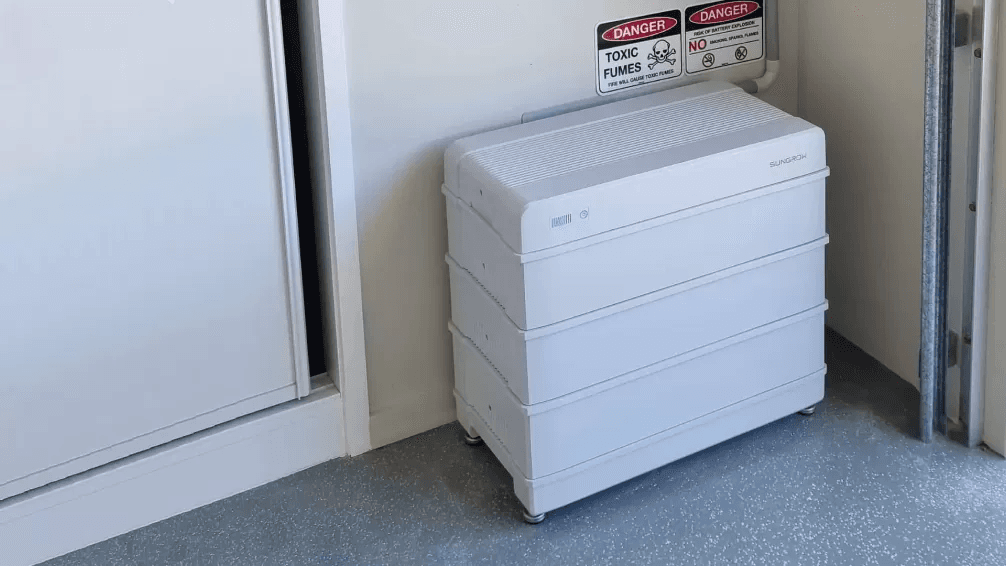

Sungrow turns up on a lot of the battery quotes we're asked to look over. It makes the inverter, it makes the battery, and it has an Australian office handling warranty, which is why we install it. It's also why the warranty conditions deserve a proper read.
Is a Sungrow battery any good?
Yes. A Sungrow battery on a matched Sungrow hybrid inverter is a well-priced, well-supported home battery, and one of the brands we install on the Sunshine Coast. Both ranges, the SBR and the newer SBH, use lithium iron phosphate (LFP) cells in stackable modules and carry a 10-year Australian warranty to 70% capacity. What you give up against a premium all-in-one like Sigenergy is a little integration and polish. What you keep is a big local support network and a price that usually sits on the value side of our range.
| Verdict at a glance | |
|---|---|
| Our rating | Strong value battery from a major brand, best on a Sungrow hybrid |
| Chemistry | LFP (lithium iron phosphate) |
| Battery ranges | SBR (3.2 kWh modules) and SBH (5.0 kWh modules) |
| Stack sizes | SBR 6.4 to 25.6 kWh; SBH 15 to 40 kWh per stack on the current Australian datasheet |
| Battery warranty (AU) | 10 years, at least 70% of initial capacity, conditions apply |
| Inverter warranty (AU) | 10 years on the SH hybrid range |
| Weak spots | Warranty needs the system online in iSolarCloud; labour is part-funded rather than fully covered |
A Sungrow battery suits you if you:
- Want a well-known brand at a sensible price per kWh
- Are installing new solar and a battery together, or replacing an old inverter anyway
- Want one brand for inverter and battery, with one app and one warranty contact
- Are on three-phase and want a hybrid that covers it
Look somewhere else if you want EV charging built into the same cabinet, you have a healthy inverter you'd rather keep and a different brand's AC battery suits it better, or the battery would sit somewhere with no reliable internet. There's a full "who shouldn't buy one" section further down.
Last updated: 26 October 2026. Specifications come from Sungrow's Australian product pages and datasheets, and warranty terms from Sungrow Australia's published warranty documents. Prices are Sunshine Coast installed bands as at August 2026. Check the current datasheet and warranty for the exact model on your quote.
The Sungrow battery range: SBR and SBH explained
Sungrow sells two high-voltage LFP battery families in Australia. They aren't interchangeable, so it's worth knowing which one you've been quoted.
SBR. The long-running range. Sungrow's Australian product page describes 3.2 kWh battery modules, two to eight modules per unit, for 6.4 to 25.6 kWh, with up to 100% usable energy and up to 30 A continuous charge and discharge. The model number tells you the size: an SBR096 is 9.6 kWh, an SBR128 is 12.8 kWh, and so on up to the SBR256.
SBH. The newer, bigger-module range. Sungrow's current Australian datasheet lists 5.0 kWh modules, three to eight per unit, for 15 to 40 kWh of usable energy per stack (SBH150 to SBH400), up to four stacks in parallel for 160 kWh, and up to 50 A continuous charge and discharge. It's IP55 rated, naturally cooled, floor-standing and approved for indoor or outdoor installation.
| Sungrow SBR | Sungrow SBH | |
|---|---|---|
| Usable kWh per module | 3.2 kWh | 5.0 kWh |
| Stackable to | 2 to 8 modules, 6.4 to 25.6 kWh | 3 to 8 modules, 15 to 40 kWh per stack; up to 4 stacks (160 kWh) |
| Chemistry | LFP | LFP |
| Continuous current | Up to 30 A | Up to 50 A |
| Enclosure | Check datasheet for the model quoted | IP55, indoor or outdoor |
| Warranty (AU) | 10 years, 70% capacity | 10 years, 70% capacity |
| Backup | Through a Sungrow SH hybrid inverter | Through a Sungrow SH hybrid inverter |
Two practical points. The SBH's higher current matters if you want serious backup output, like an air conditioner and a pool pump through an outage. The SBR's smaller 3.2 kWh steps let us size closer to what a household needs. For most Sunshine Coast homes, which use 8 to 16 kWh between about 4pm and 7am, either range gets there.
Sungrow hybrid inverters: the other half of the system
A battery is a tank. The inverter decides what it does. Sungrow's batteries pair with its own SH hybrid inverters, and the inverter you're quoted shapes your backup more than the battery does.
- SH5.0/6.0RS (single-phase): Sungrow lists 2 MPPTs, a 150% DC/AC ratio, and compatibility with both SBR and SBH batteries.
- SH8.0/10RS (single-phase): the Australian datasheet lists four MPPTs, up to 200% PV input, a built-in 63 A bypass for full-house backup, a backup switch time under 10 milliseconds, a 10-second backup peak of 13,680 VA, an IP65/C5 rating and "VPP ready".
- SH5/10T and SH15/20/25T (three-phase): 5 to 25 kW across the two ranges, IP65/C5, and compatible with SBR and SBH.
If you're on three-phase with a three-phase air conditioner or pool heat pump, a three-phase hybrid is what lets those run in a blackout. A single-phase battery inverter only backs up the circuits on its phase.
Our best solar inverters guide compares Sungrow with Fronius, SMA, Deye and others for straight solar jobs too.
Are Sungrow inverters of good quality?
In our experience, yes. Sungrow is a major manufacturer with an Australian office in North Sydney, and its Australian warranty terms give the SH hybrid range (SH5.0RS through SH10RS, and the SH-T three-phase models) a 10-year warranty from installation, capped at 11 years from manufacture. That warranty is transferable with the original proof of purchase.
That matters because the federal energy guide flags the inverter as the most common point of failure in a solar system. A brand with a local office and a claim portal is worth more than a few hundred dollars saved on an unknown one.
The caveats are the usual ones. Travel and on-site costs aren't covered outright; Sungrow pays the installer a "service rebate" toward the labour of a swap. Corrosion beyond the product's design specification is excluded, which matters on beachfront homes.
Sungrow warranty: read the conditions, not just the number
Here's what Sungrow Australia's HV battery warranty (version 8.0, effective 1 October 2024) says, in plain terms. Check whether a newer version applies on your install date.
- Term: 10 years from installation, or 126 months from the manufacturing date, whichever comes first. Don't let a battery sit in a warehouse.
- Performance: at least 70% of initial capacity at 10 years. For daily self-consumption and backup, there's no cycle limit.
- Other uses: any application outside daily self-consumption and backup is capped by a throughput figure, for example 26.88 MWh for an SBR096 and 56 MWh for an SBH200. If you plan to join a Virtual Power Plant, ask whether that counts.
- Stay online: a battery not monitored in Sungrow's iSolarCloud is listed as an exclusion. If the log data is incomplete, Sungrow says it will honour the warranty for at least four years. Sort the garage Wi-Fi before install day.
- Temperature: operating outside -20°C to 50°C ambient is excluded.
- Labour: Sungrow supplies the part and pays a standard service rebate toward labour, plus freight up to a set amount. Travel and other on-site costs aren't covered by the standard warranty.
- Adding modules later: only new modules can be added to an existing stack, and the performance warranty still runs from the original installation date.
- Changing owners: the battery warranty is given to the original end user and the document says it isn't otherwise transferable. If you're buying a house with one, ask Sungrow how it treats the new owner before settlement.
Claims go through your installer first, then Sungrow's online portal at service.sungrowpower.com.au.
How much do Sungrow solar batteries cost?
We don't publish a Sungrow-only price, because inverter size, backup wiring and switchboard work move it more than the badge does. Here are the installed bands every battery we fit falls into, as at August 2026:
| Battery size | Installed, before rebate | Federal rebate (approx.) | After rebate |
|---|---|---|---|
| 5 kWh | $8,500 to $9,500 | about $1,260 | about $7,240 to $8,240 |
| 10 kWh | $13,000 to $14,500 | about $2,520 | about $10,480 to $11,980 |
| 15 kWh | $17,500 to $19,500 | about $3,679 | about $13,821 to $15,821 |
Sungrow usually sits toward the value end of those bands for a comparable size. The reasoning is simple: the battery and hybrid inverter come from one maker, the hybrid takes solar and battery in one box, and you aren't paying for an integrated EV charger or a premium cabinet you may not use.
The rebate is worked out on usable capacity. Since 1 May 2026 it's about $252 per usable kWh for the first 14 kWh, then 60% of that from 14 to 28 kWh. Illustrative arithmetic:
- SBR096 (9.6 kWh): 9.6 × $252 = about $2,419
- SBR128 (12.8 kWh): 12.8 × $252 = about $3,226
- SBR160 (16.0 kWh): 14 × $252 = $3,528, plus 2 × $151.20 = $302, for about $3,830
The rate steps down every six months, and the usable figure that counts is the one on the Clean Energy Council approved list for that exact model. Our full breakdown of solar battery cost on the Sunshine Coast shows the working for each size.
How many solar panels to charge a 10kWh battery?
Our planning figure for the Sunshine Coast is about 4 kWh per kW of panels per day, averaged across the year. So to put 10 kWh into a battery you need roughly 2.5 kW of panels' worth of output on top of whatever the house is using during the day (10 ÷ 4 = 2.5). With 440 W panels, that's about six panels (2,500 ÷ 440 ≈ 5.7), rounded up.
In practice the house uses daytime solar first, and winter output falls below the average. That's why a 6.6 kW array often struggles to fill a 10 kWh battery in July, and why we often suggest 10 kW of panels when a battery is part of the plan.
Sungrow on the Sunshine Coast: heat, salt and storms
- Heat. The warranty excludes operating outside -20°C to 50°C ambient. A west-facing outdoor wall in a Queensland summer is the wrong spot. A shaded garage wall or a covered south side is the right one.
- Salt air. The SBH is IP55 and the SH hybrids are IP65/C5, which is a solid spec. But "corrosion over and above the design specification" is excluded from the inverter warranty, so on a beachfront block we put the gear under cover, out of the salt spray.
- Storms. Full-house backup on an SH8.0/10RS uses its 63 A bypass. On smaller hybrids, ask exactly which circuits are backed up.
- Network. Energex sets your export limit and connection type at application, before the install.
Sungrow vs Deye vs Sigenergy
| Sungrow (SBR/SBH) | Deye (HV modular) | Sigenergy SigenStor | |
|---|---|---|---|
| Module size | 3.2 kWh (SBR) or 5.0 kWh (SBH) | 5.12 kWh | 5.2 or 7.8 kWh usable |
| Inverter | Separate Sungrow SH hybrid | Separate matched Deye hybrid | Built into the stack |
| Three-phase | Yes, SH-T range | Yes, three-phase hybrids | Yes, 5 to 30 kW controllers |
| EV charging | Not in the battery stack | No | Optional DC module in the stack |
| Our positioning | Value from a major brand, strong local support | Our default on capacity and backup per dollar | Premium, tidiest install, EV-ready |
For the head-to-head with the premium option, see Sungrow vs Sigenergy. For our most-installed battery, read the Deye battery review.
Who should NOT buy a Sungrow battery
- You want EV charging in the same cabinet. Sigenergy does that (see our Sigenergy battery review); Sungrow's battery stack doesn't.
- You have a healthy, newer non-Sungrow inverter. Sungrow batteries are built around Sungrow hybrids. If your inverter is under about eight years old and working well, an AC-coupled battery alongside it is often cheaper.
- The battery would sit on a block with no reliable internet. The warranty leans on iSolarCloud monitoring. Fix the connection first.
- You want the fullest labour cover in the warranty. Sungrow part-funds labour through a service rebate. Ask your installer what their own workmanship warranty covers.
- You only need 3 to 5 kWh. The smallest SBR is 6.4 kWh. For a unit or a low-use couple, a smaller system may suit better.
Our verdict
Sungrow is a sensible, well-supported battery brand at a fair price. Paired with a Sungrow hybrid on a new system, it's a combination we're happy to put our name to. Just keep it online and know how warranty labour is handled.
If you want it sized properly against your evening usage and quoted next to an alternative, our battery installation on the Sunshine Coast starts with your interval data, not a guess.
Frequently asked questions
How much do Sungrow solar batteries cost?
On the Sunshine Coast, as at August 2026, batteries we install cost about $8,500 to $9,500 for 5 kWh, $13,000 to $14,500 for 10 kWh and $17,500 to $19,500 for 15 kWh, installed before the federal rebate. Sungrow usually sits toward the value end of those bands. The rebate, about $252 per usable kWh for the first 14 kWh since 1 May 2026, comes off the invoice.
Are Sungrow inverters of good quality?
Yes, in our experience. Sungrow has an Australian office and claim portal, and its Australian warranty gives the SH hybrid range 10 years from installation (capped at 11 years from manufacture), transferable with proof of purchase. As with any brand, labour and travel aren't fully covered, and corrosion beyond the design spec is excluded.
How many solar panels to charge a 10kWh battery?
Roughly 2.5 kW of panel output on top of your daytime use, using our planning figure of about 4 kWh per kW per day. That's around six 440 W panels' worth of surplus. Because the house uses daytime solar first and winter output is lower, a 10 kW array is often the better match for a 10 kWh battery than a 6.6 kW one.
What is the Sungrow battery warranty in Australia?
Ten years from installation (or 126 months from manufacture, whichever comes first), with at least 70% of initial capacity guaranteed at 10 years and no cycle limit for daily self-consumption and backup. The battery must be monitored in iSolarCloud, and Sungrow funds part of the replacement labour through a service rebate to the installer.