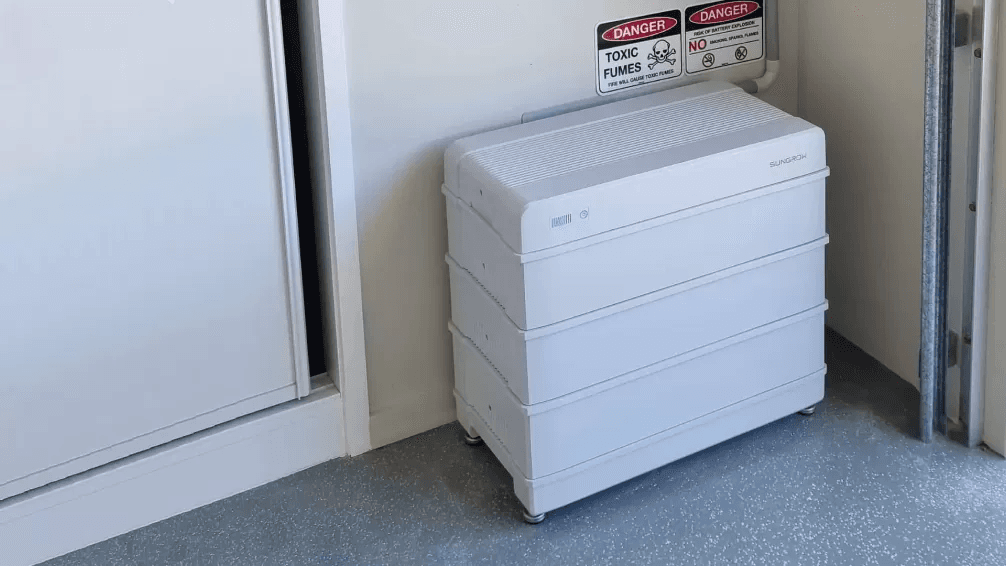

The question we get on nearly every battery site visit isn't about brands or prices. It's "can it go there?", usually while pointing at the hallway, the wall behind the TV, or the space under the stairs. The answer is often no, and the reason is a standard most homeowners have never heard of.
In Queensland, a home battery must be installed by a licensed electrician, to the battery installation standard AS/NZS 5139 and the wiring rules (AS/NZS 3000), following the manufacturer's instructions, with network approval from Energex (or Ergon in regional areas) before it's connected. AS/NZS 5139 bans batteries from habitable rooms such as bedrooms and living areas, ceiling spaces, wall cavities, under stairs and in escape routes, and sets clearances from doors, windows, vents and other appliances. In practice most Sunshine Coast batteries end up in a garage or on a shaded external wall.
This guide reflects AS/NZS 5139:2019 as amended by Amendment 1, published 19 December 2025. Standards are revised over time, and your installer applies the current version on site.
What rules apply to home batteries in Queensland?
There isn't one rulebook. A compliant battery install sits under several layers:
| Requirement | What it covers |
|---|---|
| Licensed electrician | Queensland's Electrical Safety Office says a battery energy storage system must be installed by a properly licensed electrician (WorkSafe Queensland) |
| AS/NZS 5139 | Where the battery can go, clearances, barriers, isolation, signage and documentation |
| AS/NZS 3000 (wiring rules) | General electrical installation requirements, including where switchboards can't go |
| Manufacturer's instructions | Clearances, temperature range, mounting and any locations the manufacturer prohibits |
| Network approval | Energex in South East Queensland, Ergon elsewhere; the connection application happens before installation |
| Rebate eligibility | For the federal battery rebate, a new, approved battery installed by a CEC-accredited installer |
The rebate part is worth stating clearly. The federal Cheaper Home Batteries Program takes about $252 per usable kWh off an approved battery (since 1 May 2026), applied upfront by the installer, but only if the battery is new, VPP-ready and installed by a CEC-accredited installer. A battery that's put somewhere non-compliant is a safety problem first and a paperwork problem second. Our QLD solar rebate page has the full rules.
Where can't a solar battery be installed?
The Electrical Regulatory Authorities Council (ERAC), which represents electrical safety regulators across Australia and New Zealand, published guidance on how regulators interpret AS/NZS 5139's location rules (ERAC). Under it, a battery must not be installed:
- In a habitable room. Bedrooms, studies and home offices, living, family and lounge rooms, kitchens and dining rooms, playrooms, sewing rooms, TV and music rooms, and sunrooms.
- In ceiling spaces.
- Set into wall cavities. A recess fully sealed off from the cavity with non-combustible material doesn't count as a cavity.
- On roofs, unless the roof is reached by a permanently installed staircase or fixed ladder.
- In passageways, walkways, exits, or escape and evacuation routes. That rules out hallways.
- Underneath entrance or exit walkways, staircases, or escape routes. That's the "under the stairs" question. The reasoning is simple: smoke from a battery fire could block the way out above it.
- Where it's likely to be hit, for example by a car, unless it's protected with something like a bollard.
- In a hazardous area near gas cylinders or gas relief valves, as defined in the wiring rules.
- Anywhere a switchboard isn't allowed, or anywhere the manufacturer prohibits.
What clearances does AS/NZS 5139 require?
Beyond the banned locations, there are restricted zones around openings and other equipment. Per the ERAC guidance:
| Near... | Rule |
|---|---|
| An opening window or a vent into a habitable room | Battery not within 600 mm horizontally of it, or within 900 mm below it |
| A doorway or exit 900 mm wide or less | Battery not within 600 mm of it |
| Other electrical appliances (air conditioning units, heat pumps, hot water cylinders, stoves, motors) | Not within 600 mm to the side or 900 mm above the battery |
What changed in the 2025 amendment. Amendment 1 to AS/NZS 5139:2019 was published on 19 December 2025. According to the NSW Government's advisory on it, a battery can now be installed within 600 mm of an opening wider than 900 mm, such as a garage door, and inverters are now treated as an associated appliance allowed within the restricted area (NSW Government). Queensland's Electrical Safety Office says the amendment adds guidance on location and spacing, what's permitted in restricted zones, barriers to habitable rooms and signage (WorkSafe Queensland).
On top of the standard, each manufacturer has its own clearance zones around the battery and inverter for airflow and service access. Those vary by product, so we check the installation manual for the exact model on your quote.
Can a solar battery be installed inside the house?
Not in a habitable room, full stop. But "inside" doesn't only mean living space. A garage, laundry or storeroom can work if the clearances from doors, windows and appliances are met.
Two catches:
- A garage used as a rumpus room, home gym or workspace may count as habitable. Training body GSES makes this point and recommends avoiding locations where people spend a lot of time (GSES). If the garage has become the teenager's bedroom, it's not a battery room.
- Laundries usually contain appliances, and the appliance clearances still apply. A dryer or hot water unit in the wrong spot can rule out the obvious wall.
Can I put a battery in my garage?
For most Sunshine Coast homes, the garage is the first place we look. It's non-habitable, close to the switchboard more often than not, out of the weather, and easy to service. Things we check:
- Car impact. If a car could hit the battery, it needs protection or a different spot. Bollards are the usual answer.
- The garage door. Since Amendment 1, a battery can sit within 600 mm of a wide opening like a garage door, but people still need a clear way out.
- Gas. Gas bottles and relief valves create hazardous areas the battery has to stay out of.
- Other appliances. A heat pump, hot water system or freezer in the wrong place can push the battery along the wall.
- The wall behind it. If there's a bedroom or living room on the other side, see the next section.
- Heat. A west-facing garage on the Sunshine Coast can get hot in summer. We check the manufacturer's operating temperature range against where the battery will sit.
What if the wall is shared with a bedroom?
When a battery is mounted on, or sits within 300 mm of, a wall with a habitable room on the other side, the standard requires a non-combustible barrier behind it to slow the spread of fire. The ERAC guidance says the barrier must extend at least 600 mm past each side of the battery and 900 mm above it, and if the battery is within 900 mm of the ceiling, the ceiling needs protecting too (ERAC).
Materials accepted without further testing include brick or masonry block, concrete, compressed cement sheeting, and ceramic or terracotta tiles. Timber panels, plasterboard and particle board don't qualify. Amendment 1 added a minimum thickness of 6 mm for those exempt barrier materials.
So a double-brick wall usually needs nothing extra. A timber-framed, plasterboard-lined wall, which describes a lot of Sunshine Coast homes, needs a proper barrier fitted or a different location.
Installing a battery outside on the Sunshine Coast
An external wall is the other common spot, and it brings its own local issues:
- Sun. Keep the battery out of direct sun. A south-facing wall, deep eaves or a purpose-built shroud are the usual fixes, as long as the clearances above the battery are kept.
- Salt air. Close to the beach, enclosure rating and corrosion resistance matter. Check the battery's IP rating, and think about which side of the house faces the onshore wind. Our guide to salt air and solar corrosion covers coastal installs.
- Storms. The Sunshine Coast gets heavy storms. Mounting has to suit the wall, and we avoid low spots that flood.
- Access. The battery and its isolators need to be reachable for maintenance and by emergency services.
Network approval and paperwork
In South East Queensland the battery connection goes through Energex, and the application is lodged by your installer before installation. The export arrangement at your address, including whether a dynamic connection applies, affects how the system is set up. We confirm those details at application rather than quoting a number up front.
On completion you should receive:
- a certificate of compliance for the electrical work
- the system's documentation and warranty details
- correct signage at the battery and the switchboard
- a physical copy of the battery's safety data sheet, which Amendment 1 says must be provided and protected from damage, for example in a sealed clear pouch
If a company offers to fit a battery next week without mentioning a network application, that's a red flag.
What to check on a battery quote
Before you sign, ask the installer:
- Where exactly will it go? A photo or sketch, not "in the garage somewhere".
- Is a barrier needed? And if so, what material and how big.
- What's on the other side of the wall?
- Does it need bollards or other impact protection?
- Is the installer CEC-accredited, and is the battery approved for the rebate?
- Who lodges the Energex application?
- Is backup included, and which circuits? Location affects cable runs, and cable runs affect price. Our guide to battery backup in a power outage explains essential versus whole-home backup.
If you're adding storage to existing panels, our guide to adding a battery to existing solar covers the retrofit side. For a site visit that answers the "can it go there?" question properly, see our solar battery installation page or request a free quote.
Frequently asked questions
Where is the best place to install a solar battery?
For most homes, a garage wall or a shaded external wall, ideally south-facing or under deep eaves, close to the switchboard and clear of doors, windows, vents and other appliances. The right spot also depends on the manufacturer's clearance and temperature requirements for your battery.
Can a solar battery be installed inside the house?
Not in a habitable room such as a bedroom, living room, kitchen or study, and not in a ceiling space, wall cavity, hallway or under stairs. Non-habitable spaces such as a garage, laundry or storeroom can work if the clearances are met.
Can I put a battery in my garage?
Usually, yes. Garages are one of the most common compliant locations. The installer checks car impact risk, clearance from the garage door and other exits, gas cylinders, nearby appliances and what's on the other side of the wall. A garage used as living space may count as a habitable room.
What is AS/NZS 5139?
It's the Australian and New Zealand standard for installing battery systems used with inverters. It sets where batteries can go, restricted locations and clearances, barriers to habitable rooms, isolation, signage and documentation. Amendment 1 was published on 19 December 2025.
Do I need approval to install a battery in Queensland?
Yes. The installation must be done by a licensed electrician, and the connection needs network approval from Energex in South East Queensland or Ergon in regional areas. Your installer lodges the application before the battery goes in. To claim the federal rebate, the installer must be CEC-accredited.
Can I install a solar battery myself?
No. In Queensland a battery energy storage system must be installed by a properly licensed electrician. A DIY installation also can't attract the federal battery rebate, which needs a CEC-accredited installer.